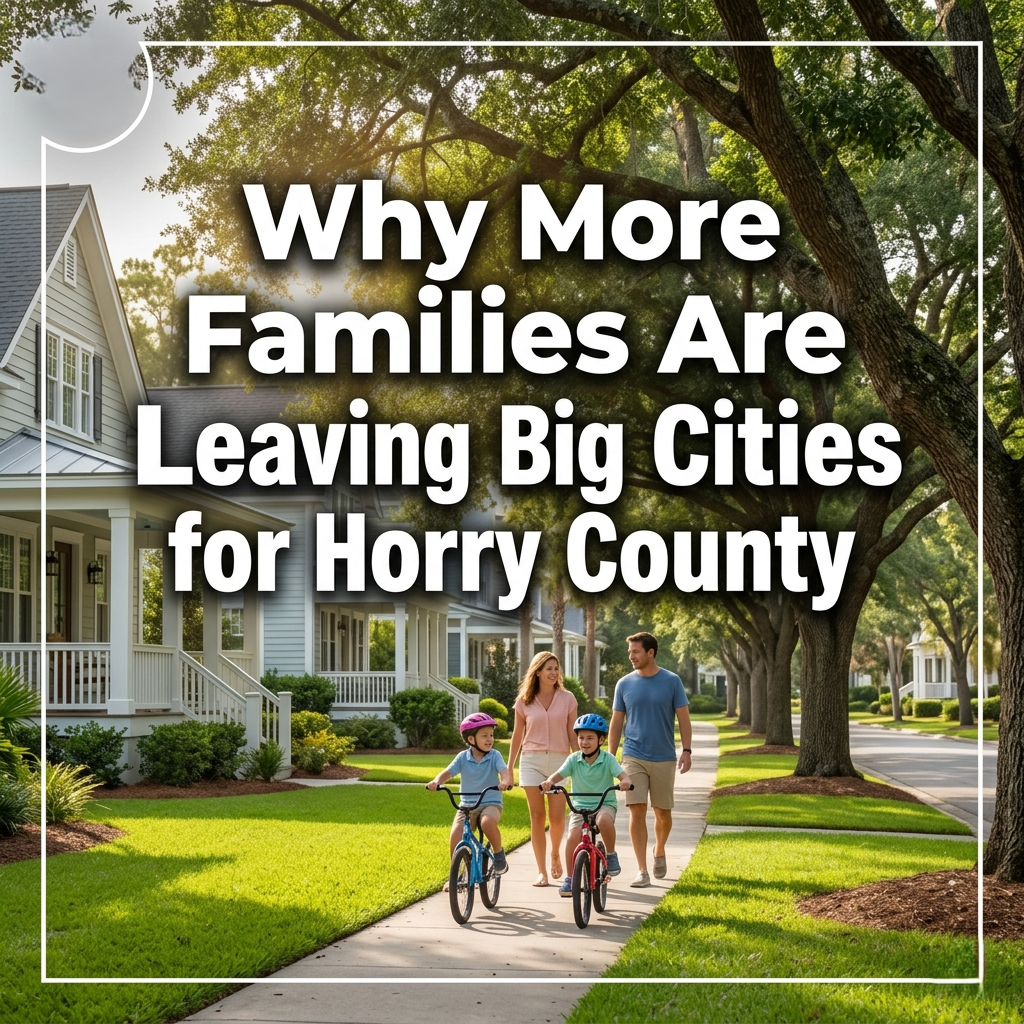
The relocation calls I take now don't sound the way they used to. Five or six years ago I'd hear from retirees a decade out from their last working year, calling because a friend bought in Myrtle Beach and they wanted to see what was available. Today I'm talking to families in their thirties and forties with remote jobs, school-age kids, and a real plan to move within the next twelve months. They're coming from the Northeast, the Mid-Atlantic, the Midwest, and increasingly from South Florida. The pattern is consistent enough now that I want to lay out what's driving it, what they're finding when they get here, and where they're actually landing.
Why Horry County Specifically
Buyers don't usually start by searching "Horry County, SC." They start by searching Myrtle Beach. What pulls them inland is the same thing that's pulled in-state buyers off the immediate coast for years: more land, lower property taxes, milder insurance costs, and neighborhoods that actually feel like neighborhoods. By the time these families have visited two or three times, they've usually figured out that Conway, Carolina Forest, Longs, and Aynor offer a different lifestyle than the resort strip.
South Carolina's property tax structure is part of the math too. Primary residences here are assessed at 4 percent of value, which is substantially friendlier than the property tax bills these families are leaving in New Jersey, Long Island, suburban Chicago, or northern Virginia. On a $400,000 home, the annual property tax difference between Horry County and many of those origin markets can run $4,000 to $8,000 a year. That's real money that ends up paying for kids' activities or a vacation.
What's Actually Driving the Move
The job piece is the unlock. Remote and hybrid work didn't fade after 2022 the way some people predicted. The families relocating to Horry County now are mostly in roles where 100 percent or 80 percent remote is permanent. The 20 percent in-office days, when they exist, are often a flight away rather than a daily commute. Myrtle Beach International handles the major hubs well enough that a once-or-twice-a-month commute is workable.
School-age kids matter too. Horry County Schools has invested heavily in new construction over the last decade. Buyers shopping Carolina Forest real estate almost always cite the schools as the primary draw. Families looking for smaller-town schools land in Conway real estate or further west toward Aynor real estate, where the school identity is part of the appeal.
Cost of housing is the obvious one. A 2,400 square-foot home with a yard runs roughly half of what the same house costs in the better suburbs these families are leaving. That difference, plus the tax difference, often funds the down payment and the move itself.
Where Families Are Actually Landing
From what I've watched closing after closing, the landing zones split fairly cleanly:
Carolina Forest pulls the buyers who want newer construction, predictable HOA amenities, and tighter school zone identity. The trade-off is smaller lots and a more suburban feel. For families coming from a corporate suburb, this is the most familiar landing pattern.
Conway pulls the buyers who want a real downtown, a historic district, more lot variety, and a slightly slower pace. CCU shapes the rhythm of the town and the buyers who land here tend to value that. Wild Wing Plantation, Carsens Ferry, and the historic streets near Main Street are the most common pockets.
Longs pulls the buyers who want new construction at a lower price point with a short drive to North Myrtle Beach. The Highway 31 connector changed the math for this area and families realized they could live in Longs real estate communities and still be at the beach in fifteen minutes.
Aynor and Loris pull the buyers who want acreage, privacy, and a school identity that hasn't been diluted by rapid growth. These buyers are usually a step further removed from city life in their origin too — they weren't living in dense urban cores, they were in semi-rural exurbs already.
The Trade-Offs Families Discover After They Move
I always tell families honestly: the move isn't free. The trade-offs that come up most often after closing are:
Healthcare specialists. Grand Strand Medical Center, Conway Medical Center, and McLeod Loris are all solid, but for very specialized care, families sometimes drive to Charleston or fly to Charlotte. If you have a complex medical condition in the family, factor this in before you commit.
Shopping and culture. Big-box and chain retail is everywhere along the Highway 17 and 501 corridors, but specialty retail, museum-quality cultural institutions, and certain international cuisines are limited compared to a major metro. Families adjust, but the first six months can be a shift.
The driving. Distances are short by Northeast standards but a lot longer than what some buyers expect. Conway to North Myrtle Beach is 30 minutes. Conway to the Charleston suburbs is over two hours. Plan accordingly.
Two Things I Tell Every Relocating Family
First, rent before you buy if you can. Even a three-month rental in Conway or Carolina Forest gives you the chance to learn which side of town actually fits your daily life. I've watched families buy on a single weekend visit and end up wishing they'd landed five miles in a different direction.
Second, visit in August. The Conway heat and humidity in late summer is real. The bugs are real. The tropical weather is real. If a family decides they still love it in August, they're going to love it the rest of the year. If August breaks them, better to know before closing.
For buyers in earlier stages of the research process, exploring the broader Myrtle Beach real estate map alongside the inland options is the comparison most families need to make their final landing-zone decision.
Key Takeaways
The wave of families leaving big cities for Horry County is no longer a pandemic story — it's a structural one driven by remote work, the South Carolina property tax structure, school investment, and the housing cost gap with the markets they're leaving. They're landing in four main pockets: Carolina Forest for newer construction and tight school zones, Conway for downtown character and lot variety, Longs for affordability with beach access, and Aynor or Loris for real space and rural character. The trade-offs after the move are healthcare specialists, specialty retail, and slightly longer drives than buyers expect. The families who do best rent before they buy and visit at least once in late summer. Horry County keeps absorbing this growth, but the right landing-zone fit depends on what these families actually value once the relocation excitement settles down.
About Greg Harrelson
Greg Harrelson is a seasoned Realtor® with more than 30 years of experience serving the Myrtle Beach and Grand Strand markets. As the founder of Century 21 The Harrelson Group, Greg has built his career helping buyers, sellers, and investors achieve success in every corner of the coastal Carolina real estate market. His expertise spans residential homes, investment properties, land development, and coastal condos. Known for his deep local knowledge, innovative marketing strategies, and commitment to personal service, Greg consistently helps clients reach their real estate goals while navigating the ever-changing market with confidence and precision.