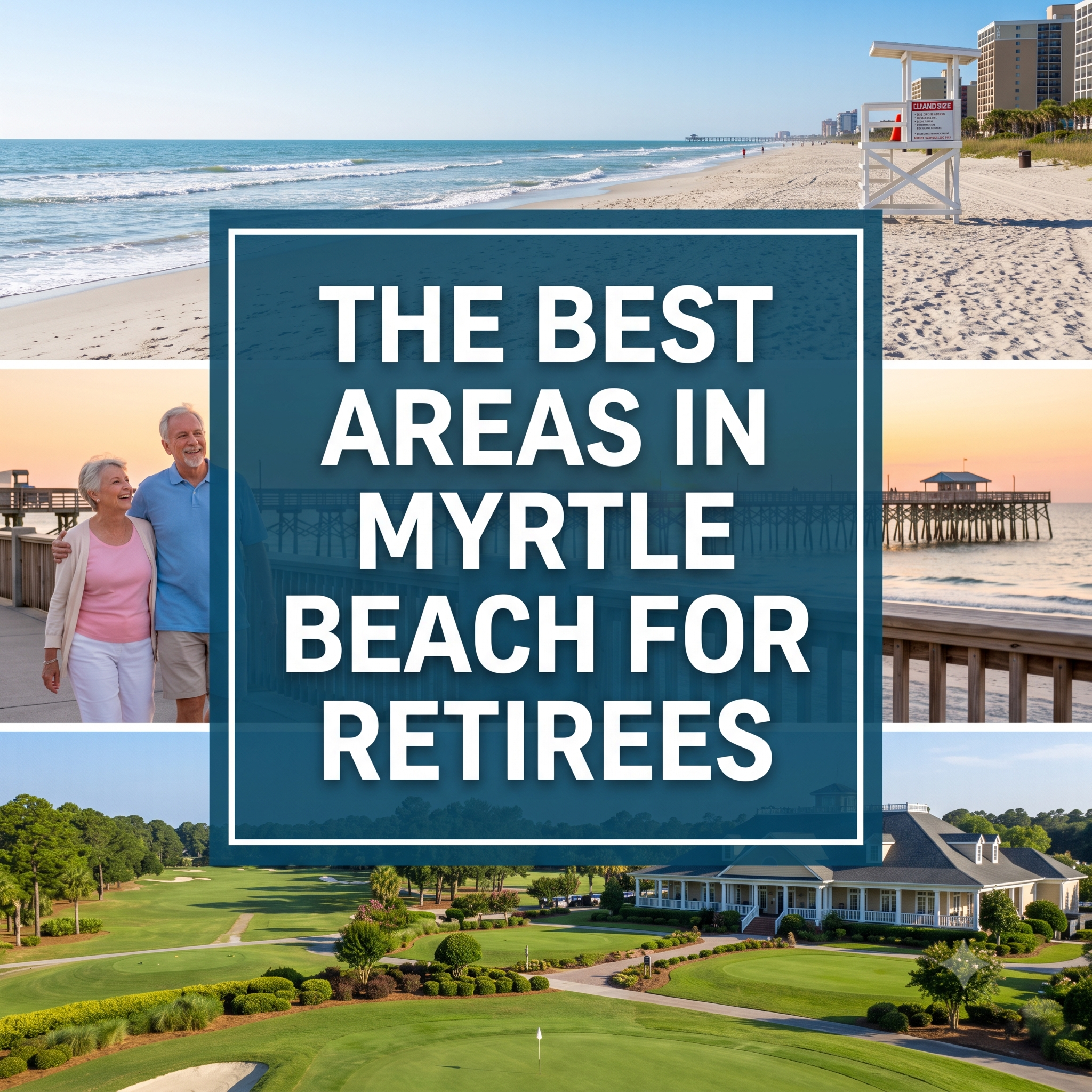
Retirees have been coming to Myrtle Beach for decades, and the reasons haven't fundamentally changed — the weather, the ocean, the cost of living compared to the Northeast and Midwest, the tax structure. What has changed is that the retirees moving here today are more discerning about which specific pocket of Myrtle Beach they land in. The retiree buyer who arrived in 1998 was often just happy to be here. The retiree buyer arriving in 2026 has done their research, knows what they want from daily life, and is choosing between very different lifestyle options within the same city. Here's how I help retirees decide which neighborhood actually fits.
What Retirees in Myrtle Beach Actually Want
The wish lists retirees show up with are consistent enough that I can predict most of them. From the closings I've watched:
- - A first-floor primary suite so stairs aren't part of daily life
- - Manageable yard size — not zero yard, but not a full-time landscaping project either
- - Proximity to healthcare, particularly Grand Strand Medical Center, Conway Medical Center, and McLeod Loris
- - A real community of other retirees for social life
- - Access to golf, pickleball, tennis, or whatever the specific retiree's sport is
- - Reasonable drive to grocery, drugstore, and daily-life essentials
- - Beach access without needing to live on top of the tourist strip
- - Predictable monthly costs — dues, taxes, insurance — that won't move dramatically in retirement
Different neighborhoods hit these different weights. Below is how the main options actually rank.
Market Common for Walkable Retiree Living
Market Common has become one of the more sought-after retiree pockets in Myrtle Beach proper. The walkable retail core with restaurants, coffee, a movie theater, and parks makes it possible to live a lot of your daily life without driving. The community events schedule is real. The single-family and townhome inventory works for retirees who want less yard than a suburban lot but more privacy than a condo.
Prices run roughly $400,000 to $700,000 for single-family, with townhomes from the $300s. HOA structures vary within Market Common, so read carefully before committing.
Grande Dunes and the Upscale North Corridor
For retirees with a bigger budget, Grande Dunes offers the higher-end lifestyle — golf, tennis, a marina, a country club, and single-family homes and condos designed with retirees specifically in mind. First-floor primary suites are standard. The community amenity package is one of the more comprehensive on the Grand Strand.
Prices start around $650,000 for smaller villas and climb well past $2 million for waterfront and golf-front custom homes. This is a specific budget target, but for retirees who can afford it, the amenity-per-dollar math often works well.
The Pine Lakes and Dunes Club Corridor
Established residential neighborhoods on the north side of Myrtle Beach — Pine Lakes, the Dunes Club area, and the surrounding streets. These are the "old Myrtle Beach" pockets that predate the resort boom. Mature trees, larger lots, more architectural variety, and a quieter feel than most of the Strand.
Retirees who want character and don't need a full amenity package often land here. Prices range from around $500,000 for older homes that need updates up to $1.5 million-plus for waterfront and oceanfront-block properties.
Carolina Forest for Retirees Who Want Suburban Predictability
Carolina Forest is not just a family neighborhood — a real share of retirees have landed here. Communities like Carolina Forest real estate offer newer homes with modern layouts, HOA-managed amenities, and enough scale that there's a real retiree community within the broader neighborhood.
Prices $400,000-$650,000 for most retiree-targeted single-family. HOA dues typically $60-$200 monthly depending on community. Golf, pool, and clubhouse access included in the higher-amenity communities.
Conway as the Inland Alternative
Not every retiree wants beach adjacency. A meaningful share of retirees I work with initially shop "Myrtle Beach" and end up buying in Conway because they realized they don't need to be next to the water. Wild Wing Plantation in Conway is a serious retiree draw with its amenity package and price point (typically $350,000-$700,000).
The historic Conway district also attracts retirees who want a real walkable downtown. Kingston Street and Main Street offer a version of small-town retirement that few coastal communities can match.
Condos as a Retirement Option
Some retirees specifically want condo life — lock-and-leave, no exterior maintenance, view of the ocean or the Intracoastal. The Grand Strand condo inventory serves this buyer well, particularly at:
- - Newer high-rise oceanfront buildings with strong HOA reserves
- - Grande Dunes condo communities
- - North Myrtle Beach condo buildings with more residential feel than resort feel
- - Golf and marina condo communities in Little River
The critical question for retiree condo buyers is HOA financial health. A retiree on a fixed income cannot easily absorb a $15,000 special assessment. Always read the reserve study and meeting minutes carefully before going under contract.
Golf-Focused Retirees
Retirees who golf regularly should factor course quality and proximity heavily. The Grand Strand's course quality varies significantly, and course closures have hit certain communities over the last decade. The safer picks tend to be communities where the golf course ownership is stable and where the amenity structure doesn't depend entirely on one course staying open.
Wild Wing Plantation, Long Bay-area communities in Longs, Grande Dunes, and the Barefoot Resort area on the north end all have historically stable golf operations. For broader golf-focused options, browsing Conway golf course homes or Myrtle Beach real estate inventory with a golf filter gets you started.
Healthcare and Convenience Access
This is the item that shifts in importance as retirees age. The neighborhoods with the shortest drives to real healthcare:
Grande Dunes and the north corridor — Grand Strand Medical Center is minutes away.
Market Common and Carolina Forest — close to specialty offices and urgent care.
Carolina Forest — Conway Medical Center is 10-15 minutes.
Conway proper — Conway Medical Center is a few minutes; specialty offices are along Highway 501.
For retirees who anticipate ongoing healthcare needs, the drive time question sometimes overrides other neighborhood preferences.
Two Things I Tell Every Retiree Shopping Myrtle Beach
First, budget the whole retirement carrying cost, not just the mortgage. Property tax at the primary residence rate, insurance including wind and hail, HOA dues, healthcare, transportation, and normal cost of living all matter. Retirees on fixed incomes who don't do this math sometimes end up house-poor two years in. The right home is the one where the total cost fits your income comfortably, not the one that stretches you thin.
Second, prioritize a home you can age in place in. First-floor primary suites, low-threshold showers, wide doorways, and predictable one-story layouts all matter more over time than they seem at 62. Even for retirees who plan to move again in 10 years, the ability to age in place if plans change is a real financial and quality-of-life protection.
Key Takeaways
- - Market Common offers walkable retiree living with real community and predictable HOA structures ($300s townhomes to $700k+ single-family)
- - Grande Dunes hits the upscale amenity-focused retirement niche ($650k+, with real depth above $1M)
- - Pine Lakes, Dunes Club corridor offers character and larger lots for retirees who want established neighborhood feel
- - Carolina Forest works for retirees who want suburban predictability with a real retiree community mixed in
- - Conway (Wild Wing Plantation, historic district) is the inland alternative for retirees who don't need beach adjacency
- - Condo life works for lock-and-leave retirees but demands careful HOA reserve study review
- - Healthcare access, HOA financial health, and the ability to age in place are the three factors that matter most over time
- - Budget the whole retirement carrying cost, not just the mortgage payment
About Greg Harrelson
Greg Harrelson is a seasoned Realtor® with more than 30 years of experience serving the Myrtle Beach and Grand Strand markets. As the founder of Century 21 The Harrelson Group, Greg has built his career helping buyers, sellers, and investors achieve success in every corner of the coastal Carolina real estate market. His expertise spans residential homes, investment properties, land development, and coastal condos. Known for his deep local knowledge, innovative marketing strategies, and commitment to personal service, Greg consistently helps clients reach their real estate goals while navigating the ever-changing market with confidence and precision.