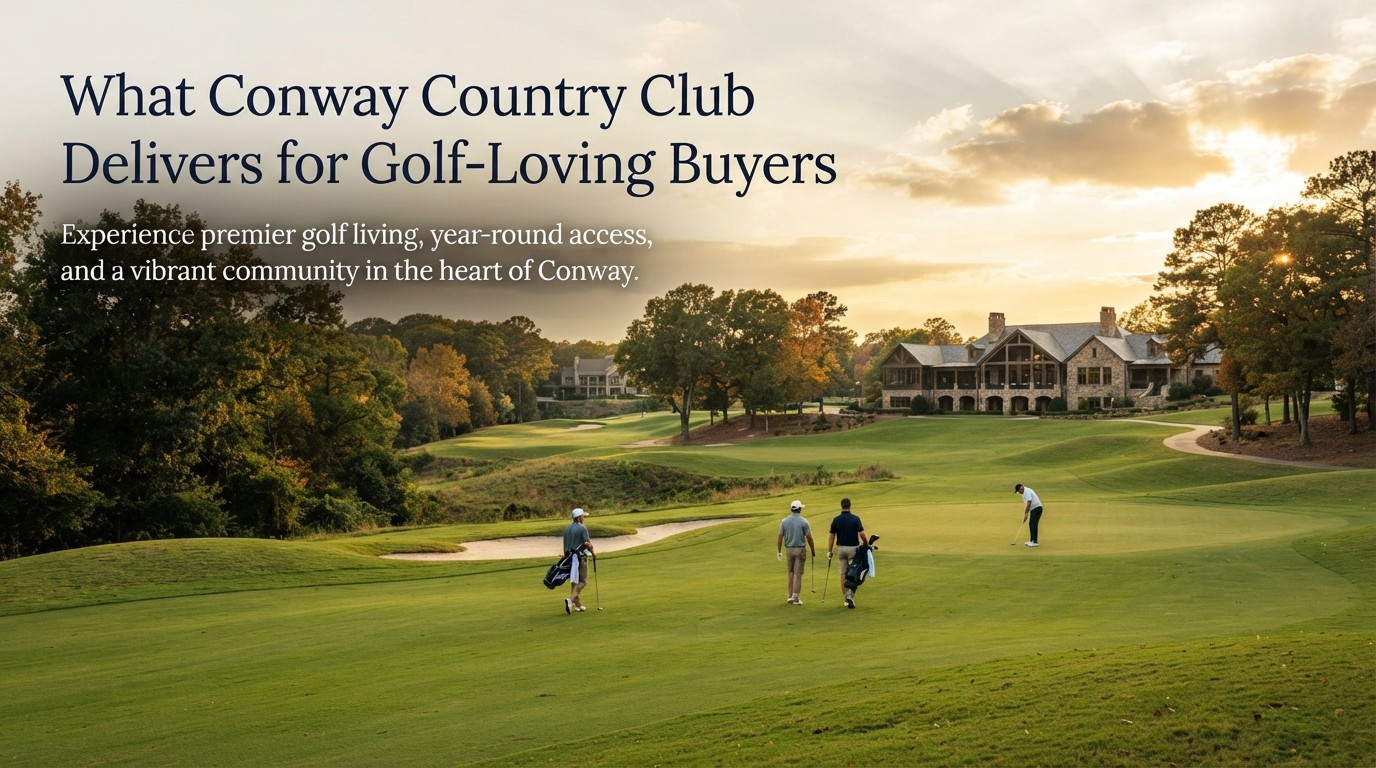
You golf regularly and want a home that puts the course at the front of your daily life. On the Grand Strand there are only a few communities that actually deliver on that promise, and Conway Country Club is one of them. Here's the honest picture. It's not the flashiest golf community on the strand. It's not the largest. What it is, is one of the more established, quietly consistent golf-adjacent neighborhoods in the Conway market — and for the right buyer, that's exactly the point.
Why Conway Country Club Matters in This Market
The Grand Strand has dozens of golf courses. That doesn't mean every course-adjacent community is a good place to live. What separates a solid golf community from a marketing brochure is course stability, home quality, community identity, and the specific fit between the amenity and the residents.
Conway Country Club has held up in ways some other Grand Strand golf communities haven't. The course has stayed operating. The neighborhood identity has stayed intact. The homes have been maintained and updated by owners who genuinely wanted to live there rather than by flippers looking for a quick turn.
Who Actually Buys Here
The Conway Country Club buyer pool has a few consistent patterns.
Retirees who golf regularly and want the course as their daily amenity, not a once-a-month feature. Living on or near the course means the golf lifestyle is embedded in daily life.
Snowbirds who spend fall through spring in Conway and want the golf-community setup that makes their winter months easy. Lock-and-leave friendly, active community, and a course they can actually play.
Full-time residents who value the established neighborhood feel and don't want the resort intensity of some larger golf communities further south.
Move-up buyers from other Conway pockets who want a lifestyle upgrade tied to the golf they already play.
What Makes the Community Actually Work
A few specific features that come up in almost every conversation with residents.
Established landscaping and mature trees. The community has been around long enough to feel like a real neighborhood, not a raw new subdivision.
Real course access. Homes here aren't just theoretically near the course — you can walk or drive a cart to the tee.
Manageable community scale. Small enough that neighbors know each other, big enough to have real community events and social structure.
A quieter version of coastal SC. You're 15-20 minutes from Myrtle Beach and 25 minutes from the actual ocean. Enough proximity to hit the beach when you want. Enough distance that daily life happens in a residential neighborhood rather than a tourist corridor.
What Golf-Focused Buyers Should Verify
Standard golf community due diligence applies here too.
The specific club membership structure. Some Grand Strand golf communities require mandatory club dues for all residents. Others make membership optional. Ask exactly what's required and what's optional at Conway Country Club before signing anything.
Course ownership stability. Ask about who owns the course, how the finances look, and whether there are any pending ownership changes. Course closures happen on the Grand Strand and they crush home values in the surrounding neighborhoods.
HOA reserves. Established communities can face capital projects — clubhouse updates, road resurfacing, pool renovation. A healthy reserve position means these projects don't hit you as special assessments.
Play volume. If the course is being played, it's staying profitable. If it's empty on weekends, that's a sign to ask harder questions.
For broader inventory across Conway's golf-oriented options, browse Conway golf course homes alongside Conway Country Club to see how the market looks in your price range.
The Golf Cart Question That Matters
Not every Conway neighborhood is golf cart friendly. Some are. Some aren't. If you plan to use a golf cart around your neighborhood — not just on the course — check the specific rules before you commit. Golf cart friendly neighborhoods in Conway lists the specific communities that support the golf cart lifestyle beyond just course access. Conway Country Club has the pieces that support this kind of daily use, but confirm the specifics for your particular street.
What Conway Country Club Homes Look Like
The inventory here isn't cookie-cutter. Homes range from established mid-tier options that have been owned by the same family for years to updated properties refreshed for modern buyers to occasional luxury builds. If you're looking at the higher end of the Conway market, Conway luxury homes often includes properties in this pocket, alongside other high-end Conway options.
What consistently sells fastest here: well-maintained homes with course frontage or short-walk-to-tee access, updated kitchens, first-floor primaries, and outdoor space that leverages the course view.
What Golf Community Buyers Underestimate
Two patterns worth flagging.
The maintenance load on golf-adjacent homes. Mature landscaping needs care. Windows in course-facing homes get more attention. Balls hit windows, sprinklers overspray, and cart paths need occasional adjacent maintenance. Budget for these realities.
Club dues if applicable. If the community includes required club membership, factor that into your total monthly carrying cost. It can add meaningfully to what your monthly ownership actually costs.
Two Things I Tell Every Conway Country Club Buyer
First, play the course before you buy. Sounds simple. Almost no buyers do it. Renting a cart and playing 18 tells you more about the course quality, the resident engagement, and whether the amenity you're paying for actually matches what you want than any marketing tour ever will. Play first.
Second, talk to a current resident about their annual budget. HOA dues, club fees, cart fees, and incidental charges add up in ways brochures don't fully capture. Fifteen minutes with a neighbor gives you the real number, and the real number often changes how you underwrite the purchase.
Key Takeaways
- Conway Country Club is one of the more established, consistent golf communities on the Grand Strand — quieter than resort-scale alternatives but reliably solid
- The buyer pool includes retirees, snowbirds, full-time residents, and move-up golfers from other Conway pockets
- Established landscaping, real course access, manageable community scale, and quieter coastal SC positioning are the specific value drivers
- Verify club membership structure, course ownership stability, HOA reserves, and play volume before committing
- Conway Country Club supports golf cart use for buyers who want that lifestyle beyond just course access
- The inventory ranges from established mid-tier homes to occasional luxury builds; well-maintained properties with course frontage sell fastest
- Budget for golf-adjacent home maintenance and any required club dues in your total carrying cost
- Play the course before you buy and talk to a current resident about their real annual budget
About Greg Harrelson
Greg Harrelson is a seasoned Realtor® with more than 30 years of experience serving the Myrtle Beach and Grand Strand markets. As the founder of Century 21 The Harrelson Group, Greg has built his career helping buyers, sellers, and investors achieve success in every corner of the coastal Carolina real estate market. His expertise spans residential homes, investment properties, land development, and coastal condos. Known for his deep local knowledge, innovative marketing strategies, and commitment to personal service, Greg consistently helps clients reach their real estate goals while navigating the ever-changing market with confidence and precision.