Myrtle Beach has close to a hundred golf courses and the brochures treat them all like they're interchangeable. They aren't. If you're buying a home in a golf community here, the course is almost beside the point — the community around it is what you're actually buying into. Here's what separates the Grand Strand's real golf communities from the ones that just have a course nearby.
Grande Dunes — The Luxury Benchmark
Grande Dunes sits along the Intracoastal Waterway and takes up a sizable chunk of the north Myrtle Beach area. The community has two courses — the Resort Course and the Members Club — and the Members Club is one of the few true private clubs in the market. Grande Dunes also has a Marina Village, a Mediterranean-style community center, oceanfront amenities, and some of the most consistent price appreciation in Myrtle Beach. Buyers coming here are usually looking for a full lifestyle package, not just a course to play.
What I see consistently with Grande Dunes buyers is that they're buying the community first, the course second. The resale value tracks the amenity picture more than the fairway condition.
Pine Lakes — The Grand Daddy with Established Charm
Pine Lakes is where the Grand Strand's golf story really started — the original Myrtle Beach course, opened in 1927, is here. The community around it has mature trees, lower-density housing, and homes that run the range from mid-market to legacy properties. The vibe is quieter and more residential than resort-style. Buyers who want a golf course address without the tourist flow often land here.
Myrtlewood — Central Location, Two Courses, Good Value
Myrtlewood sits inland from the strip, with two courses (Palmetto and Pinehills) and a mix of condos and single-family homes. The community gives you a central location, workable prices for a golf-adjacent lifestyle, and reasonable HOA fees. It's not oceanfront, it's not ultra-luxury — it's a solid middle lane for buyers who want to play regularly without buying into a resort premium.
TPC Myrtle Beach — Serious Course, Specific Buyer
TPC Myrtle Beach is one of the top-rated public courses in the state and the community around it draws buyers who want that caliber of golf as a daily option. Housing stock here is newer and higher-end than Myrtlewood, and the pace is quieter than resort communities closer to the beach. If golf is the point of the move, TPC is worth touring.
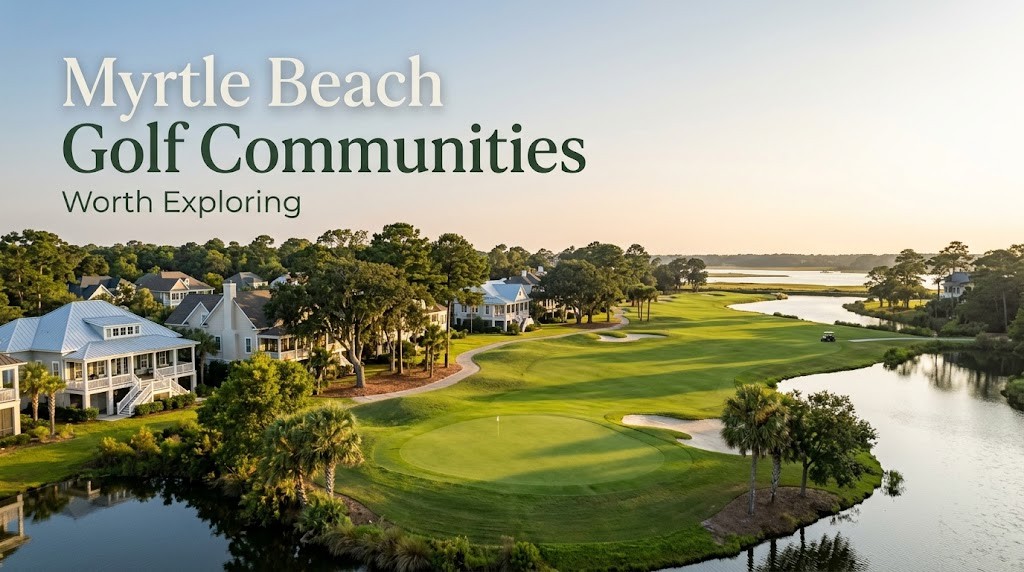
Legends Resort — Three Courses and a Village Feel
Legends sits inland, has three distinct courses (Heathland, Moorland, Parkland), and feels more like a self-contained village than a subdivision. The homes range from villas and condos to larger single-family houses. Price points work for a lot of retiree budgets, and the course variety keeps a daily player interested year-round.
Barefoot Resort — North of Myrtle Beach, Four Courses
Technically in North Myrtle Beach, Barefoot gives you four courses designed by big names (Love, Fazio, Norman, Dye), a yacht club, and a mix of condos, townhomes, and single-family homes. Buyers drawn to North Myrtle Beach for the beach-plus-golf lifestyle often start here. It's one of the few communities in the market where you can realistically play a different course every day of the week without leaving home base.
Caropines, Blackmoor, and the Secondary Tier
Beyond the headline communities, there's a secondary tier worth knowing about — Blackmoor over in Murrells Inlet, Caropines in Surfside, International Club in Murrells, Tradition Golf Club in Pawleys. These are usually quieter, less amenity-heavy, and priced below the headline communities. They're worth touring if you want golf course access without the resort infrastructure or price point.
How to Pick the Right One
Three questions sort most buyers quickly. One: do you want a resort feel with amenities and seasonal buzz, or a quiet residential neighborhood that happens to have a course? Two: how important is private vs. semi-private vs. public club access? Three: how far from the beach do you want to be? Grande Dunes and Barefoot give you water-close options. Legends, TPC, and Myrtlewood are inland. Pine Lakes and Myrtlewood sit in between.
Walk the community during peak season and off-season. HOA documents, cart path condition, course maintenance, and clubhouse condition tell you more than any marketing site. If you want golf-course homes beyond these headline communities, our Conway golf-course homes list is a good starting point for the inland tier.
Key Takeaways
Myrtle Beach golf communities aren't interchangeable — Grande Dunes, Pine Lakes, Myrtlewood, TPC, Legends, and Barefoot each attract a different buyer for different reasons. Grande Dunes leads on luxury and amenities, Pine Lakes on charm and legacy, Myrtlewood on value and location, TPC and Legends on course quality, Barefoot on course variety. Decide whether you want a resort or a residential community, how important private membership is, and how close you need to be to the beach, then walk the community in different seasons before you commit.
About Greg Harrelson
Greg Harrelson is a seasoned Realtor® with more than 30 years of experience serving the Myrtle Beach and Grand Strand markets. As the founder of Century 21 The Harrelson Group, Greg has built his career helping buyers, sellers, and investors achieve success in every corner of the coastal Carolina real estate market. His expertise spans residential homes, investment properties, land development, and coastal condos. Known for his deep local knowledge, innovative marketing strategies, and commitment to personal service, Greg consistently helps clients reach their real estate goals while navigating the ever-changing market with confidence and precision.