Atlantic hurricane season runs June 1 through November 30 every single year. Peak activity typically hits mid-August through October. If you own a home along the Grand Strand — whether you're in Coquina Harbour or an inland pocket well away from the coast — the annual preparation ritual matters. Homeowners who prep systematically before June 1 handle storm season without drama. Homeowners who wing it usually spend at least one season learning why systematic prep matters. Here's what to actually do every year.
Why Annual Prep Matters Even in Quiet Seasons
Not every hurricane season produces a major landfall. But every hurricane season produces tropical activity, high wind events, heavy rain, and the possibility of storm surge along the coast. Homeowners who prep for the possibility of a major event handle even the minor ones better.
The prep isn't dramatic. Done in the right sequence starting in April or May, it takes a weekend or two and eliminates most of the last-minute scramble when a storm actually threatens.
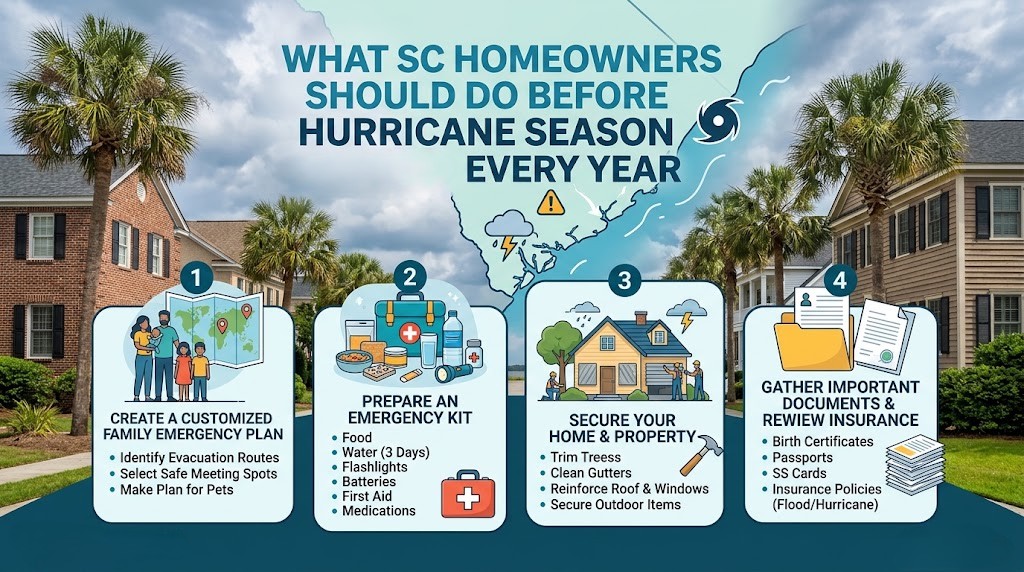
April: The Insurance and Documentation Check
Start the year by verifying your insurance situation is current and understood.
Confirm your homeowner's policy is active with no lapse. Confirm your wind and hail policy is active. Confirm your flood policy is active if you have one. All three layers need to be verified before storm season, not during.
Review coverage limits and deductibles. Percentage-based hurricane deductibles on wind and hail policies can be much higher than you remember. Understanding what you'd pay out of pocket if a storm hit matters for both financial planning and repair decisions.
Document your home's current condition. Walk through every room with your phone, video the contents, photograph exterior condition. Store the documentation in cloud storage. If a claim ever happens, this baseline documentation makes the process much smoother.
Update your emergency contact list — insurance agent, insurance company claims number, HVAC contractor, plumber, roofer, closest neighbor or property manager, family members who need to reach you.
May: The Exterior and Landscape Prep
The exterior work matters most and can be done gradually through the month.
Trim trees and shrubs. Any limbs within 10 feet of the roof, windows, or power lines should be cut back. Dead limbs anywhere near the house should be removed. This single task prevents more roof damage than any other prep item.
Clean gutters and downspouts. Standing water in blocked gutters during a heavy rain leads to roof and foundation issues. Spring cleaning matters more than fall cleaning in this context.
Inspect and clean roof surface. Look for missing shingles, damaged flashings, worn caulking around penetrations. Address issues before storm season rather than during.
Test hurricane shutters if you have them. Verify all fasteners are in place. Practice deploying them. Store them where they can be accessed quickly.
Confirm the location of your water shutoff valve, gas shutoff, and main electrical panel. Test that they work. Know how to access them in emergency conditions.
Early June: The Supply and Systems Check
By the start of hurricane season, you should have your supply situation in order.
Stock hurricane supplies now, not the day before a storm arrives. Water (one gallon per person per day, three-day minimum), non-perishable food, first-aid supplies, medications, flashlights, batteries, portable radio.
Confirm generator operation if you have one. Change the oil, test the electrical connections, store fresh fuel with stabilizer.
Charge portable battery packs for phones. Verify car chargers work.
Service HVAC before peak season. A tuned system handles the heat and humidity that follows storms better than one carrying accumulated issues.
Refill any prescription medications with extra supply. Pharmacies get overwhelmed when storms approach.
Ongoing Through Season: The Weather Monitoring Routine
Once June 1 passes, monitoring becomes part of the routine.
Sign up for local emergency alerts through Horry County and your specific municipality if applicable. These provide better local information than national weather services.
When a named storm develops in the Atlantic, start monitoring daily. Cone of uncertainty projections change over time.
When a storm enters the 5-day cone, start preparing specific items — move outdoor furniture inside, secure loose exterior items, top off vehicle fuel, review evacuation routes if you're in an evacuation zone.
When landfall projections narrow, deploy hurricane shutters, complete any remaining preparation, and either shelter in place or evacuate based on the specific situation and your evacuation zone.
What Full-Time vs. Second-Home Owners Should Prep Differently
Ownership type changes the preparation calculus.
Full-time residents can complete last-minute prep in the days before landfall. The prep runway can be shorter because you're at the property.
Second-home and snowbird owners need to complete more prep ahead of time because you can't easily return to handle last-minute items. Consider engaging a local property manager who can deploy shutters and secure the property if you're not available.
Coastal properties in Ocean Drive, Cherry Grove, or barrier-island equivalents need more aggressive prep than inland properties in Longs real estate. Storm surge, wind exposure, and evacuation requirements differ meaningfully.
The Communication Plan Nobody Sets Up Until It's Too Late
Family communication during storms is often overlooked in prep.
Establish a family communication plan — who calls whom, what alternative contacts exist if phones fail, where to meet if evacuation becomes necessary, who has the master emergency contact list.
Share property access information with an out-of-state family member. If you're evacuated and someone else needs to check on the property afterward, they should have the necessary information.
Establish a "safe" check-in system. When a storm affects your area, family members waiting to hear from you need clarity about when and how you'll communicate.
What Storm Season Teaches Every Year
Two patterns worth noting.
Small storms create real damage more often than headline hurricanes. Broken tree limbs, minor roof issues, power outages, and minor flooding happen most seasons. The prep for major storms also handles minor events better.
The homeowners who suffer worst are usually the ones who assumed the season would be quiet. Assuming quiet doesn't hurt anyone in years when the season actually is quiet. Assuming quiet costs real money in years when it isn't.
For homeowners in barrier-adjacent inventory or specific NMB pockets, browse North Myrtle Beach real estate to understand which properties face higher exposure than others.
Two Things I Tell Every SC Homeowner About Hurricane Season Prep
First, prep once, prep thoroughly, and prep before June 1. Homeowners who systematically prepare in April and May don't scramble when storms threaten. Homeowners who plan to prep "when we hear something" often find the local supply stores empty of what they need. The calm-weather prep window is short. Use it.
Second, don't ignore mid-season maintenance. A storm-free July doesn't mean the season is quiet. Peak activity historically hits August through October. Complete any deferred prep by early August so you're ready when the historical peak arrives.
Key Takeaways
Grand Strand homeowners should run a systematic hurricane routine every year, starting in April. April is for insurance verification and photographing current condition. May is exterior work — tree trimming, gutter cleaning, roof inspection, shutter testing, and confirming shutoff valves. Early June wraps up supplies, generator testing, and HVAC service; once the season starts you monitor weather and adjust as storms enter the cone. Second-home owners need a faster response plan than full-timers, and family communication planning gets overlooked until it's too late.
About Greg Harrelson
Greg Harrelson is a seasoned Realtor® with more than 30 years of experience serving the Myrtle Beach and Grand Strand markets. As the founder of Century 21 The Harrelson Group, Greg has built his career helping buyers, sellers, and investors achieve success in every corner of the coastal Carolina real estate market. His expertise spans residential homes, investment properties, land development, and coastal condos. Known for his deep local knowledge, innovative marketing strategies, and commitment to personal service, Greg consistently helps clients reach their real estate goals while navigating the ever-changing market with confidence and precision.