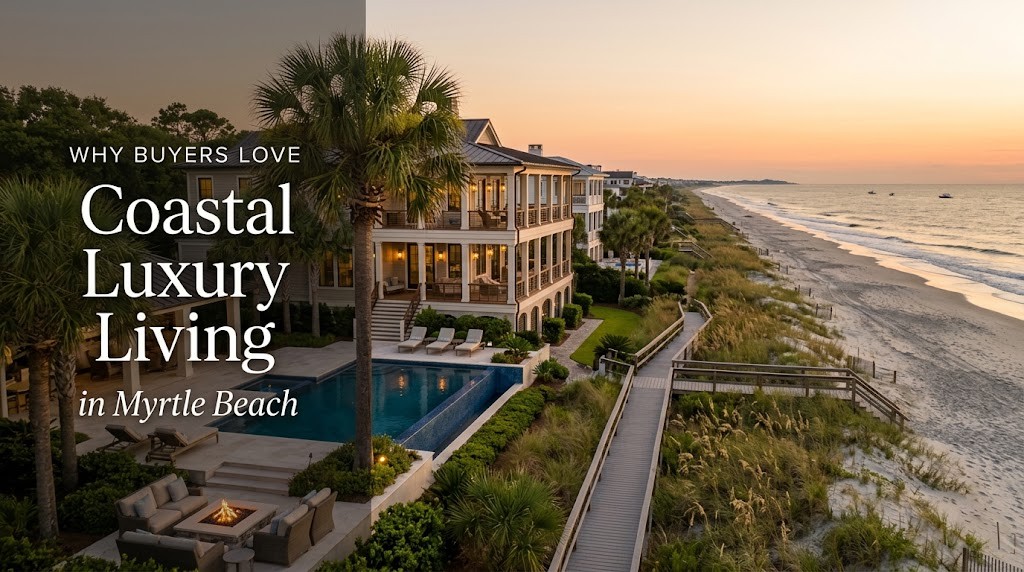
Coastal luxury in Myrtle Beach doesn't look like coastal luxury in Palm Beach or Naples, and that's part of the appeal. Buyers moving here from higher-priced markets consistently tell me the same thing: the money goes further, the lifestyle is less performative, and the real amenity is the water itself. Here's what luxury actually means in this market, and why the buyers who move here tend to stay.
Luxury in Myrtle Beach Means Four Different Things
The word gets thrown around loosely, so let's split it. Oceanfront luxury — direct beachfront homes and penthouse condos. Waterway luxury — estates and boat-access homes along the Intracoastal and connecting river systems. Private club luxury — Grande Dunes Members Club and similar gated communities built around a serious golf course. Resort luxury — higher-end properties inside amenity-heavy communities like Grande Dunes and Barefoot Resort. Each tier draws a different buyer and holds value for different reasons.
Buyers who confuse these tiers tend to overpay for one feature while missing the one they actually wanted. The oceanfront buyer who really wanted private club access ends up disappointed. The private club buyer who missed the water access regrets it after year one.
Oceanfront Is the Headline, But Not Always the Right Pick
Direct oceanfront commands a real premium — and for the right buyer, it's worth every dollar. Waking up to the Atlantic, walking down to the sand in slippers, watching storms roll in from the deck — nothing substitutes for it. The trade-offs are real though. Insurance stacks hard, salt air works on finishes, HOA dues on oceanfront condos run higher than most inland buyers expect, and short-term rental activity in some buildings can make day-to-day living feel more hotel-adjacent than residential.
The oceanfront buyers who thrive here are the ones who actually use the water. The ones who buy for the view and rarely leave the house usually sell within three years.
The Waterway Tier Keeps Underwriting Itself
Homes along the Intracoastal Waterway, the Waccamaw River system, and the canals in Cherry Grove and Little River have quietly outperformed most other tiers in appreciation over the last decade. Boat access, protected water, lower insurance exposure than direct oceanfront, and privacy you can't get on the beach. Grande Dunes along the ICW is the headline neighborhood. Smaller enclaves along the Waccamaw north of Conway and the canals south of Little River are the sleepers.
What I see consistently is that waterway buyers skew long-term. They settle in, buy a boat, join a marina, and don't sell for a decade. That stability keeps supply tight and prices firm.
Private Club Luxury Trades Features Oceanfront Can't
Private club communities like Grande Dunes Members Club and higher-end sections of Pine Lakes trade features oceanfront buildings don't offer — private golf, resident-only amenities, controlled membership, and a social fabric that forms around the club. For buyers moving from established country-club markets up north, this is often the piece they were hunting for. The tier draws a different demographic than oceanfront — often older, more residential, less seasonal.
Resort Luxury Combines Amenities With Beach Access
Resort-style luxury communities — Grande Dunes as a whole, Barefoot Resort in NMB, Dunes Golf and Beach Club — give buyers the full package. Clubhouse, pools, oceanfront amenities (via community beach clubs in some cases), gated privacy, high-end dining nearby, and golf. Price points typically run between pure oceanfront and traditional private club communities. The lifestyle is more active than private club, less exposed than oceanfront.
Price Bands and What They Actually Buy
Luxury in Myrtle Beach starts earlier than most migrating buyers assume. Resort and waterway luxury runs well into seven figures but opens below many comparable coastal markets. Oceanfront moves higher, with premium direct beachfront reaching deep into the eight figures for the top tier. Private club entry points vary widely by community. Buyers moving from New York, Boston, or Northern California frequently remark that their current home's price would buy multiple homes here — and they're not exaggerating.
If you want to walk the price bands yourself, start with the mid-range Myrtle Beach price band page and work up to see what each tier delivers.
The Lifestyle That Keeps Buyers Here
Coastal luxury buyers don't stay for one thing — they stay for the combination. Year-round golf. Boating on the ICW. Oceanfront dining. Short flights from Myrtle Beach International. Lower state income tax than many of the markets they came from. Mild winters. A healthcare system that's grown substantially over the last decade. For retirees and second-home owners, that stack is hard to beat.
Here's what nobody tells you until you move: the social scene in these communities is more welcoming than most newcomers expect. Private clubs here aren't the gatekept rooms of older money markets. New residents get introduced quickly, which is why the migration out of this market is low once people settle.
Who Should Actually Buy Luxury Here
Buyers who want ocean, boat, golf, or private club access as a daily reality. Buyers who've lived in high-tax northeastern markets and want a lifestyle upgrade at a lateral or lower monthly cost. Second-home owners from the Carolinas, the Northeast, and the Midwest who want warmer winters without going as far as Florida. The buyer who thinks they want a trophy address but will never use the water usually doesn't love it here — and that's okay. The buyers who come for the lifestyle itself consistently outperform their own expectations.
Key Takeaways
Coastal luxury in Myrtle Beach splits into four distinct tiers — oceanfront, waterway, private club, and resort — and each one attracts a different buyer for different reasons. Oceanfront commands the headline premium but demands a buyer who actually uses the water. The waterway tier (Grande Dunes along the ICW, Cherry Grove canals, Waccamaw River) quietly outperforms on long-term appreciation. Private club and resort communities trade different features that oceanfront can't deliver. Pick the tier that matches how you'll actually live, not the one with the loudest marketing.
About Greg Harrelson
Greg Harrelson is a seasoned Realtor® with more than 30 years of experience serving the Myrtle Beach and Grand Strand markets. As the founder of Century 21 The Harrelson Group, Greg has built his career helping buyers, sellers, and investors achieve success in every corner of the coastal Carolina real estate market. His expertise spans residential homes, investment properties, land development, and coastal condos. Known for his deep local knowledge, innovative marketing strategies, and commitment to personal service, Greg consistently helps clients reach their real estate goals while navigating the ever-changing market with confidence and precision.