If you want to live in Myrtle Beach but you'd rather walk to dinner than drive, Market Common is where you look first. Built on the old Myrtle Beach Air Force Base, the neighborhood ignores the usual Grand Strand pattern of highway-and-strip-mall development and gives you something closer to a real town square. Buyers who end up here almost always say the same thing after a few months: they didn't realize how much they wanted this until they tried it.
What Market Common Actually Is
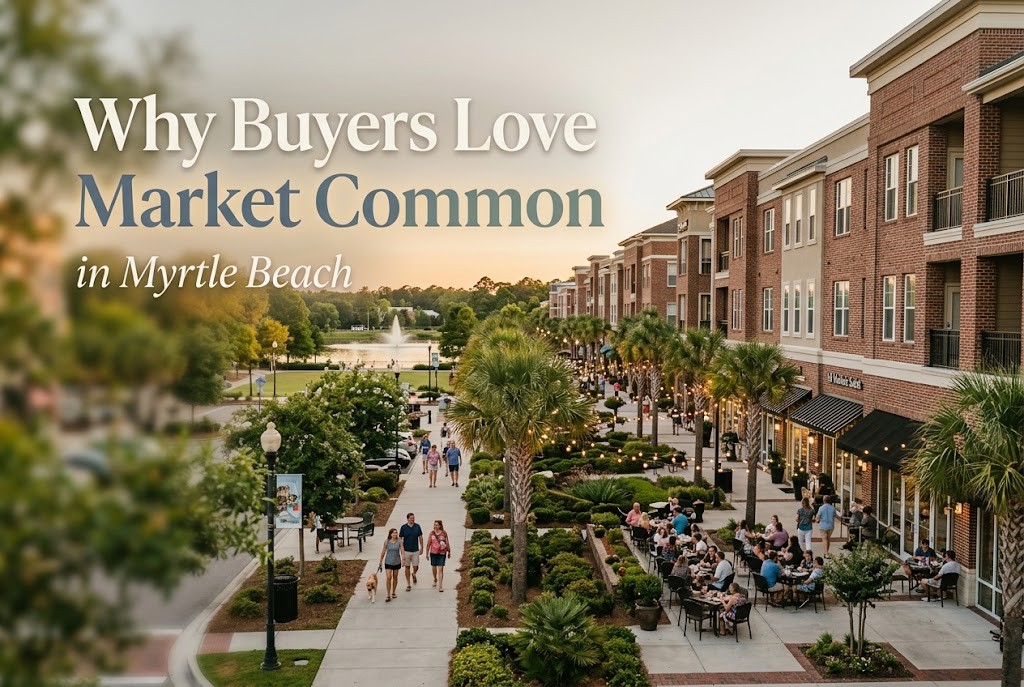
Market Common is a mixed-use neighborhood just inland of the beach, built around a walkable commercial core with shops, restaurants, a movie theater, a weekly farmers market, and public green space. Residential sits around and above the commercial district — condos over storefronts, townhomes on tree-lined streets, single-family homes within a short walk of the center. Grand Park and Valor Park anchor the open space side, and the Myrtle Beach State Park and the beach itself are a short drive out.
The scale matters here. Market Common isn't a strip of shops with houses nearby. It was planned as a neighborhood from day one, with sidewalks, bike paths, and streets designed to slow cars down.
Why Walkability Is the Whole Point
Here's the thing about most of Myrtle Beach — the lifestyle is beach-and-car. You drive to the sand, you drive to dinner, you drive to the grocery store. Market Common breaks that. Residents walk to coffee in the morning, to the farmer's market on Saturday, to a show at the theater, to Grand Park with the dog. That daily rhythm is why so many retirees and remote workers pick this neighborhood over oceanfront condos. The beach is still a ten-minute drive. But most of life happens on foot.
Who Thrives Here
Retirees who want a walkable base. Remote workers who need coffee shops and dinner options without a car. Families who want their kids to have a place to ride bikes safely. Buyers coming from northeastern towns with walkable downtowns who don't want to lose that lifestyle just because they moved south. What I see consistently with Market Common buyers is that they tour the neighborhood once, go home to think, and come back ready to write. The format sells itself.
The buyers who don't love it are usually ones who wanted direct oceanfront and tried to compromise on inland walkability instead. If beach access every morning is the point of your move, this isn't the right fit.
Housing Options Inside Market Common
The housing mix is wider than most Grand Strand neighborhoods. Condos over the commercial core run smaller and give you true walk-to-everything life. Townhomes on streets like Howard Avenue, Nevers Street, and Bellamy Avenue sit in the middle on price and give you a small yard with the walkability still intact. Single-family homes in sections like Sweetgrass Square and The Reserve at Market Common sit a few blocks out, with more land but a longer walk to the center.
Price points cover a wider band than people assume. Entry-level condos stay reasonable, and the higher end of the single-family inventory moves into premium territory. If you want to see where mid-range Myrtle Beach homes cluster for comparison, our mid-band price page is a good starting point.
What Residents Actually Do on a Normal Week
Monday morning coffee at a sidewalk cafe. Lunch meetings at a dozen restaurants within a five-minute walk. Weekly farmers market on Saturday morning. Live music nights in the warm months. Movie theater in the center for a rainy afternoon. A short drive out to the beach when you want sand under your feet. Dinner options that rotate — residents here develop favorites but rarely eat the same place twice in a week.
What people underestimate is how much the social fabric forms around the walkability. Neighbors run into each other at the coffee shop, at the park, at the grocery store. That's how friendships form here faster than in car-dependent neighborhoods.
The Trade-Offs to Know Before You Buy
Nothing is perfect. Market Common has busier weekends and peak-season weeks when tourists find their way in — especially for the farmer's market and holiday events. HOA fees in some sub-communities are higher than inland Myrtle Beach alternatives. Condo buildings in the walkable core can carry noise from the commercial activity below — nothing extreme, but something to notice if you're a light sleeper. And if you need serious boat storage or want a four-car garage, this isn't the format for you.
The buyers who do best here tour at different times of day, walk the specific blocks they'd actually live on, and talk to residents at the coffee shops before writing an offer.
How It Compares to Other Myrtle Beach Options
Oceanfront gives you direct beach but no walkable commercial life. Grande Dunes gives you resort amenities but you drive to everything outside the gates. Carolina Forest gives you suburban space and schools but no neighborhood center. Carolina Forest and Conway trade walkability for more land and lower price per square foot. Market Common is the only Myrtle Beach neighborhood built from the ground up as a walkable mixed-use center. If walkability matters to you, it's the pick.
Key Takeaways
Market Common gives Myrtle Beach buyers something no other local neighborhood does — a true walkable mixed-use center where daily life happens on foot. It fits retirees, remote workers, and families who want sidewalks and community character over car-dependent beach living. Housing ranges from condos over the commercial core to single-family homes a few blocks out, with HOA fees that reflect the amenity picture. Tour the neighborhood at different times, walk the specific streets you'd live on, and talk to residents before you write.
About Greg Harrelson
Greg Harrelson is a seasoned Realtor® with more than 30 years of experience serving the Myrtle Beach and Grand Strand markets. As the founder of Century 21 The Harrelson Group, Greg has built his career helping buyers, sellers, and investors achieve success in every corner of the coastal Carolina real estate market. His expertise spans residential homes, investment properties, land development, and coastal condos. Known for his deep local knowledge, innovative marketing strategies, and commitment to personal service, Greg consistently helps clients reach their real estate goals while navigating the ever-changing market with confidence and precision.