Myrtle Beach resort communities are their own segment of the market, and buyers who don't understand how they work sometimes make expensive mistakes. Resort communities operate under different rules than standard subdivisions. The HOA structures are more complex. Rental economics are baked into how the buildings function. The buyer pool is a mix of full-time residents, second-home owners, and investors that creates specific dynamics you don't see in normal residential neighborhoods. After thirty-plus years of writing offers on resort community properties, I want to lay out what buyers need to understand before writing a single check.
What Actually Defines a Resort Community
The term "resort community" gets used loosely, but real resort communities share specific features:
Amenity infrastructure designed for vacationers as well as residents. Pools with lifeguards. Restaurants on premises or immediately adjacent. Fitness centers. Sometimes golf, tennis, or beach services.
HOA structures that include maintenance of common resort elements — lobbies, front desks, pool complexes, exterior building maintenance.
A mix of unit ownership types — some owner-occupied, some second homes, some in rental programs.
Higher HOA dues than standard residential subdivisions, reflecting the amenity load.
Rental programs often available for owners who want to hand off the rental management to the resort itself.
Different building code and insurance considerations because of the mixed-use nature.
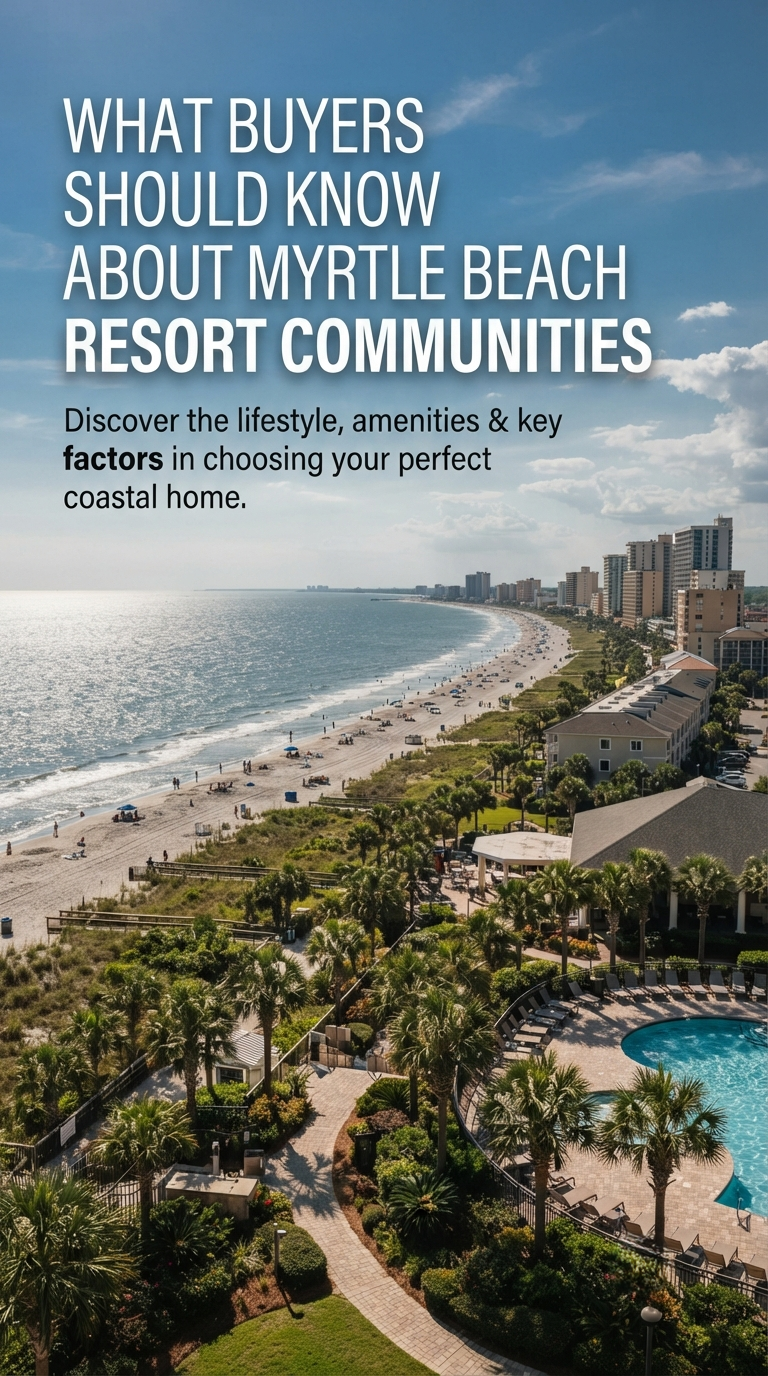
Where Myrtle Beach Resort Communities Are Located
The main resort community concentrations:
The direct oceanfront strip. Multiple oceanfront buildings function as resort communities — hotel-style front desk service, rental programs, amenity packages, and mixed ownership. These range from older properties from the 1970s and 1980s to newer luxury builds.
Grande Dunes. The Grande Dunes complex includes both resort-style condo buildings and single-family communities with amenity access. The country club, marina, and resort infrastructure define this pocket.
Barefoot Resort on the north end. Golf, community amenities, and multiple condo and townhome complexes that function collectively as a resort community.
Kingston Plantation. A specific resort community on the north side of Myrtle Beach with condos, villas, and amenity structure.
Various oceanfront and near-oceanfront condo buildings that operate as smaller-scale resort communities.
For broader context, browsing Myrtle Beach real estate inventory alongside North Myrtle Beach real estate gives you a sense of how resort community pricing compares to standard residential inventory.
The HOA Structure Is More Complex Than Buyers Expect
Resort community HOAs typically manage far more than a standard subdivision HOA. They handle building exteriors, common area amenities, security, sometimes water and sewer, sometimes insurance for the building envelope, and often the rental infrastructure.
That means HOA dues are higher — sometimes $400 to $1,500+ monthly depending on the community and amenity package. It also means special assessments hit differently. When a building needs a new roof, a balcony repair, or a pool complex overhaul, the cost gets spread across the ownership. Special assessments of $5,000 to $25,000 per unit are common in aging resort communities.
Buyers should:
Read the last three years of HOA meeting minutes carefully. Look for mentions of pending projects, ongoing repairs, and any hints of deferred maintenance.
Review the most recent reserve study. A community with healthy reserves relative to expected capital needs is far safer than one with underfunded reserves.
Ask about upcoming assessments. Sellers must disclose known assessments, but pending discussions can slip past disclosure requirements.
Verify what the HOA dues actually include. Some cover water. Others don't. Some cover flood or building insurance. Others require owners to carry it separately.
Rental Programs Have Real Trade-Offs
Many resort communities offer on-site rental management programs. Owners hand over the unit for rental during periods they aren't using it, and the resort handles bookings, cleaning, guest services, and maintenance. The resort takes a commission (typically 40-60 percent of gross rental income).
Advantages:
Complete hands-off management for owners who don't want to deal with tenants.
Professional operational infrastructure with scale that individual owners can't match.
Access to booking channels and marketing that individual owners can't easily replicate.
Trade-offs:
Commission structure takes a large share of gross rental income.
Owners lose some control over pricing, tenant selection, and unit configuration.
Unit condition and finishes may need to meet resort program standards, which can require investment.
Independent rental (through Airbnb, VRBO, or direct booking) can produce higher net income for owners willing to do the work themselves, but not all resort communities allow independent rental.
Building Insurance vs. Personal Insurance
Resort community buyers must understand the split between master policy coverage and owner-required coverage:
The building's master insurance policy typically covers the structure itself, common areas, and sometimes basic finishes ("walls in" coverage).
The individual owner is typically responsible for the interior finishes and personal property — appliances, cabinetry, flooring, furniture. This requires a separate HO-6 condo policy.
Wind and hail coverage may be split between master and owner policies in complex ways. Read the master policy declarations carefully.
Flood insurance may be required separately for units on lower floors even in buildings with master policies.
The Investment Reality
Resort community investment properties can produce meaningful income, but the gross-to-net gap is bigger than in standard rental properties:
Rental management commission of 40-60 percent for on-site programs, or 20-30 percent for independent management with a third party.
Higher HOA dues than standard residential.
Higher insurance because of the layered structure.
Higher maintenance because of vacation-rental wear.
Higher property tax at the 6 percent non-primary-residence rate.
Realistic net-to-gross ratios often run 25-45 percent depending on the community and management approach. Investors underwriting on gross numbers routinely overestimate returns.
Two Things I Tell Every Resort Community Buyer
First, read every HOA document before removing your inspection contingency. The bylaws, the rules and regulations, the meeting minutes, the reserve study, the master insurance policy, and the current dues and assessments. This paperwork tells you what you're actually buying. Buyers who skip this step routinely get surprised after closing.
Second, understand your own use case before choosing between resort programs. If you'll use the property four weeks a year and want zero hassle the rest of the time, the on-site rental program is often the right answer despite the commission. If you'll use the property twelve weeks a year and want to maximize income the rest of the time, independent management may work better. If you'll live in it full-time, both are usually irrelevant. Match the community structure to your actual plans.
Key Takeaways
Myrtle Beach resort communities operate as a distinct market segment with more complex HOA structures, higher dues, mixed ownership dynamics, and rental infrastructure that changes both the ownership experience and the investment economics. The main concentrations are along the oceanfront, at Grande Dunes, Barefoot Resort on the north end, Kingston Plantation, and various smaller resort-style condo buildings. Buyers need to review HOA meeting minutes and reserve studies, understand what building insurance covers versus what personal insurance covers, and match the resort's rental program structure to their intended use of the property. Investment returns are more nuanced than gross rental numbers suggest — realistic net-to-gross ratios of 25-45 percent are common. Buyers who do their document review before removing inspection contingencies consistently avoid the surprises that catch other resort community buyers. The right resort community for the right owner is a great long-term investment. The wrong choice is a persistent source of frustration and cost.
Frequently Asked Questions
Can I live full-time in a Myrtle Beach resort community?
Yes, most resort communities have full-time owners mixed with second-home owners and rental units. Some buildings have restrictions on residency, but most don't. Understanding your building's rules is part of due diligence.
Are rental programs mandatory in resort communities?
Usually no. Most resort communities let owners choose whether to enroll units in the rental program. Some higher-end communities are strictly owner-occupied. A few require rental participation to keep amenities funded, but this is unusual.
What's the difference between a resort community condo and a regular condo?
Resort community condos typically have hotel-style front desk service, on-site rental infrastructure, more extensive amenities, higher HOA dues, and building operational structures designed to accommodate transient guests. Regular condos are pure residential without the resort infrastructure.
Do resort community HOAs raise dues frequently?
Yes, more than standard residential HOAs. Amenity operations, insurance, and maintenance costs rise over time, and resort HOAs pass those increases through. Budget for annual dues increases of 3-8 percent when running long-term ownership numbers.
Can I finance a resort community condo?
Sometimes, but with more difficulty than standard condos. Some resort buildings don't meet conventional lending standards because of owner-occupancy ratios, HOA reserve levels, or master policy structures. Confirm financing options during the pre-approval process before committing to a specific building.
About Greg Harrelson
Greg Harrelson is a seasoned Realtor® with more than 30 years of experience serving the Myrtle Beach and Grand Strand markets. As the founder of Century 21 The Harrelson Group, Greg has built his career helping buyers, sellers, and investors achieve success in every corner of the coastal Carolina real estate market. His expertise spans residential homes, investment properties, land development, and coastal condos. Known for his deep local knowledge, innovative marketing strategies, and commitment to personal service, Greg consistently helps clients reach their real estate goals while navigating the ever-changing market with confidence and precision.