Coastal Carolina University has done more to shape the Conway market in the last ten years than most people realize. When I started selling here in the early '90s, CCU was a quieter regional school. Today it's a Division I program, the campus has expanded across both sides of Highway 544, and there's a steady wave of buyers who specifically want to live within a short drive of it. Some are parents buying for a student. Some are alumni who came for school and never left. Some are investors who figured out that rent checks from college tenants don't bounce as often as people assume. Here's what that part of the Conway market actually looks like.
Where the CCU Area Sits in the Conway Market
CCU's main campus is off Highway 544 on the south side of Conway, sandwiched between the city proper and the Carolina Forest area. That location is the reason this part of town has grown faster than almost any other. You're 15 minutes from downtown Conway, 20 minutes to Myrtle Beach, and 10 minutes from Carolina Forest schools and shopping. The road network is the catch. Highway 544 carries a lot of traffic between campus, the beach, and the hospital corridor, especially between 7:45 and 9 a.m. and again at afternoon dismissal. If you live and work along it, you learn the cut-throughs quickly.
For shoppers, the most useful starting point is the broader Conway real estate map. CCU-adjacent inventory ranges from sub-$200,000 condos to half-million-dollar single-family builds, with a lot of activity in the $250,000 to $400,000 band.
Why Parents Buy Here
Parents who buy near CCU usually do the math like this: their child needs housing for four years, the dorm or apartment lease will run thousands a year, and Conway home prices are reasonable compared to the rest of the country. They buy a small home or a condo, the student lives there with a roommate, and the parents either sell when school ends or hold the property as a rental.
I've helped a lot of families through this exact scenario. The clients who end up happiest tend to do three things:
- Buy something simple and durable, not the prettiest unit
- Pick a community with reliable maintenance and security
- Sign a real, written roommate lease, even between friends
Where Alumni and Faculty End Up
Alumni who graduated from CCU and decided to stay tend to drift to the historic side of Conway near Main Street, or into newer construction at Carsens Ferry and along the Highway 905 corridor. Faculty members often want a quieter commute and choose homes off the back roads toward Aynor. Several alumni families have also landed at Wild Wing Plantation when they want amenities, a golf course, and a true neighborhood feel. The pattern I've watched for years is that the people who fall in love with Conway as students usually want a real neighborhood once they buy, not a student-feeling community.
That's worth remembering as a buyer. Some communities near campus carry a steady student rental presence and the wear that comes with it. Others are full-time owner-occupied and you'd never know a university was nearby. Walk both during a weekday evening before you decide.
The Investor Angle on CCU
Investors have been a real part of this market for over a decade. The math has changed as prices climbed, but it still pencils out for the right property. Here's what I see working right now:
- 2- and 3-bedroom condos in the $150,000 to $250,000 range with HOA dues that don't eat the cash flow
- Older townhomes within walking distance of campus, especially in communities that allow long-term rentals
- Small single-family homes with 3 or 4 bedrooms where each room can be leased separately to students
The key variable is HOA rental policy. Some communities have tightened up on rentals over the last few years, and a few cap the number of rentals allowed at any given time. I tell every investor client to request the HOA's current rental rules in writing before going under contract. Verbal answers from a leasing agent are not enough.
If you're looking at the condo side specifically, Conway condos for sale includes a number of buildings that have historically performed well with student tenants.
Lifestyle Pieces That Matter More Than Buyers Expect
Game days. CCU football and baseball weekends shift the entire south side of Conway. Streets close, traffic backs up, and parking gets creative. If you're a tailgater, it's a feature. If you work from home and need a quiet Saturday morning, plan around the home schedule.
The walkability question. Some communities near campus genuinely let students walk or bike to class. Others look close on a map but require a dangerous crossing of Highway 544. Don't assume from the listing photos. Drive the actual route.
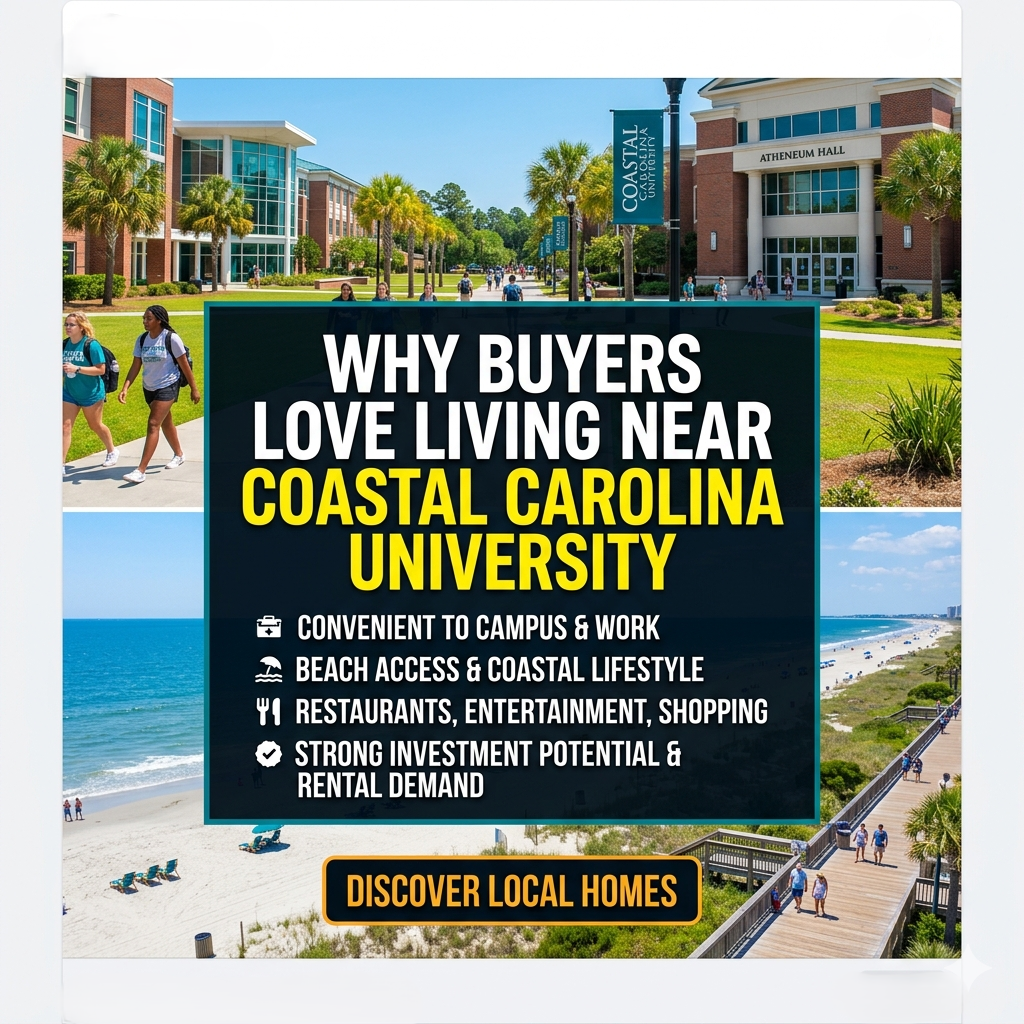
The dining and grocery layer has caught up nicely. Conway Medical Center, the Costco on 501, the Tanger Outlets, and the restaurants near the campus give residents real options without driving to the beach. Five years ago that was not true.
Two Things I Tell Every CCU-Area Buyer
First, the academic calendar matters when you list a rental. Leases here run with the school year. If you close in November on a property you plan to rent, you may sit empty until August. Build that into your numbers.
Second, insurance and maintenance budgets on student-occupied homes need to be higher than a typical owner-occupied property. Things break faster. Floors take more abuse. Plan for it, and the investment still works. Pretend it won't happen, and it'll catch you the first year.
For families targeting nearby schools rather than the university, Astoria Park is another community worth a look, since its inventory and price points often overlap with what CCU-area buyers shop.
Key Takeaways
- Coastal Carolina University shapes the south side of Conway more than most outside buyers realize
- The market includes parents buying for students, alumni settling in, faculty, and long-term investors
- Highway 544 traffic and CCU's home football and baseball schedule both affect daily life more than buyers expect
- Investor success depends heavily on HOA rental rules and a realistic maintenance budget
- Some communities feel like real neighborhoods and others feel like student housing - walk both at night before deciding
- Inventory ranges from sub-$200,000 condos to $500,000+ single-family homes, with most activity in the $250,000-$400,000 band
About Greg Harrelson
Greg Harrelson is a seasoned Realtor® with more than 30 years of experience serving the Myrtle Beach and Grand Strand markets. As the founder of Century 21 The Harrelson Group, Greg has built his career helping buyers, sellers, and investors achieve success in every corner of the coastal Carolina real estate market. His expertise spans residential homes, investment properties, land development, and coastal condos. Known for his deep local knowledge, innovative marketing strategies, and commitment to personal service, Greg consistently helps clients reach their real estate goals while navigating the ever-changing market with confidence and precision.