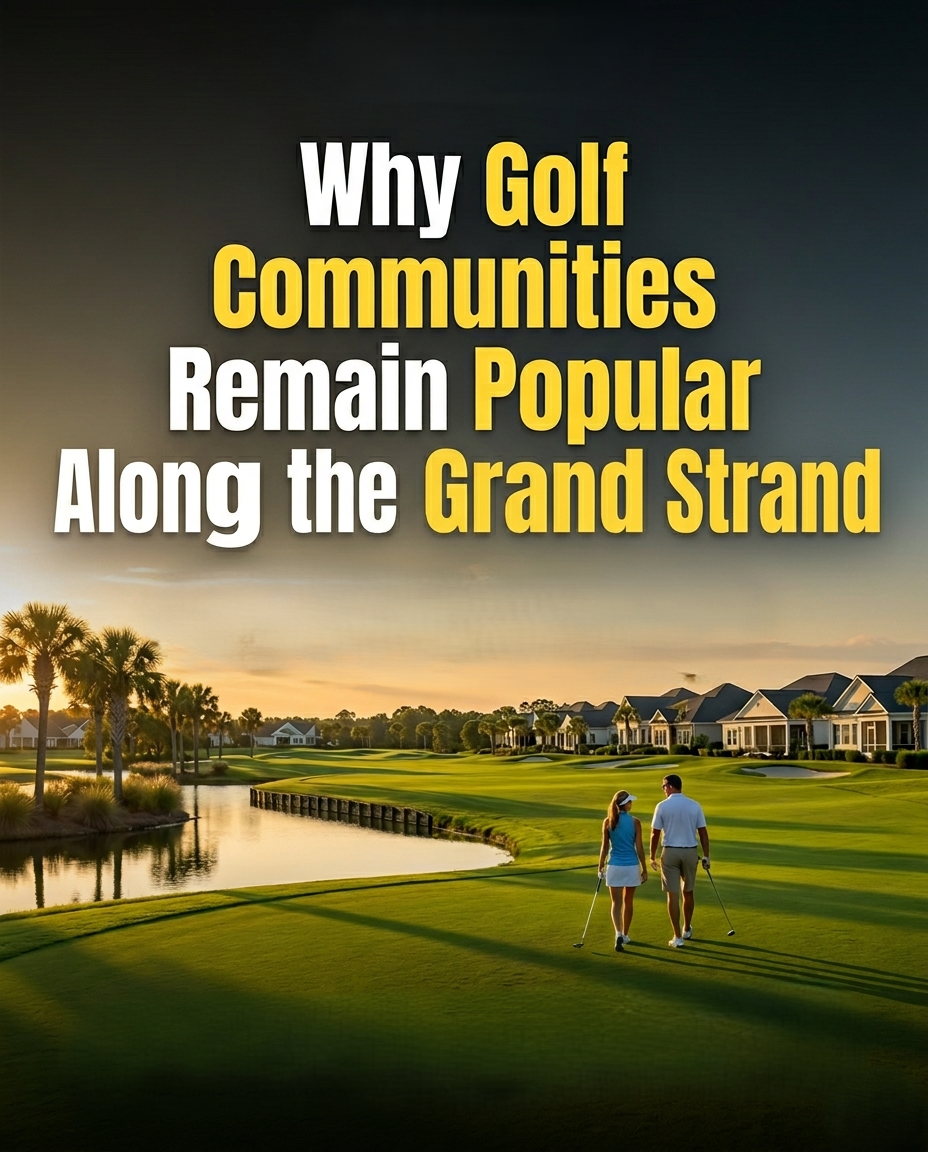
The Grand Strand has been a golf market since long before it was a relocation market, and that history shapes how the real estate works today. There are over 90 courses spread between Pawleys Island and Calabash, and many of them anchor neighborhoods that were designed around the fairways. Decades after the original golf boom of the 80s and 90s, these communities haven't faded the way some predicted. If anything, the buyer interest has broadened. Here's how I think about golf community real estate after thirty-plus years of selling along the Strand, and which pockets are worth a serious look right now.
Why the Buyer Pool for Golf Communities Hasn't Shrunk
A lot of national real estate writers assumed golf communities would lose appeal as younger buyers turned away from the sport. That hasn't happened on the Grand Strand, and there are specific reasons:
The amenity package isn't just golf. Modern Grand Strand golf communities have layered in clubhouses with restaurants, multiple pools, fitness facilities, pickleball, tennis, walking trails, social calendars, and gated security. A buyer who never picks up a club still uses the pool, the gym, and the dining room every week.
The lot quality is usually better than the surrounding market. Fairway lots, water-feature lots, and conservation-area lots inside golf communities offer views and buffers that non-golf subdivisions can't replicate. Even non-golfer buyers respond to the view.
The HOA covenants tend to be stricter, which protects resale values. The neighborhoods don't get visually neglected the way some open subdivisions do, because the architectural and landscaping rules are enforced.
And the resale buyer pool is broader than people think. Even if a future buyer doesn't golf, they'll value the same things current owners value: established trees, predictable maintenance, security, and a real community feel. That broad pool is what holds prices up.
Wild Wing Plantation: Conway's Anchor Golf Community
Wild Wing Plantation has been the anchor golf community on the Conway side of the market for years. The Avocet course is the centerpiece, but the lakes, the pool complex with water slides, and the clubhouse drive a lot of the amenity appeal. Inventory ranges from townhomes in the low $300s to custom waterfront builds well past $700,000. Wild Wing pulls families, retirees, and second-home buyers at the same time, which is rare for a single community and a real strength on resale.
The Long Bay Pocket on the North End
Long Bay Golf Course up near Longs has anchored a steady residential community for decades. The Park at Long Bay and The Reserve at Long Bay both pull a steady mix of full-time retirees and second-home buyers. The course itself has held up well, and the HOA in this pocket is more active than most Longs communities. Buyers either appreciate that or find it heavy, depending on temperament.
Eastport and the Little River Golf Pocket
Little River has its own golf community history. Eastport Golf Homes and Eastport Golf Condos sit on a course that's been part of the Little River market for years. The condo product gives buyers a lower-entry-price option to live inside a golf community, which works particularly well for snowbirds who don't need the full single-family footprint. River Hills is another option in this corridor with its own course and a more residential feel.
The Conway Golf Course Market More Broadly
Beyond Wild Wing, Conway has a broader collection of homes on or near courses. The Burning Ridge area, the Quail Creek pocket, and various properties around Conway Country Club all show up in the Conway golf course homes inventory. These are often smaller-community options that may not carry the full amenity package of Wild Wing but offer fairway lots and the same lifestyle at lower price points.
What to Look At When Considering a Golf Community
Beyond the obvious "is the course nice" question, the items I push buyers to evaluate are:
The financial health of the course itself. Some Grand Strand courses are owned by the HOA. Others are owned by separate operators who lease the land or operate on independent terms. A course that's struggling financially can close, and a closed course immediately drops the surrounding home values noticeably. Ask hard questions about ownership structure and recent revenue trends before you commit.
The HOA's mandatory club membership rules. Some golf communities require all residents to pay club dues, golf or not. Others make membership optional. The required-dues model can be a real ongoing cost for non-golfers — sometimes $200 to $600 a month above the basic HOA. Make sure you know exactly what's required.
The maintenance cycle on the course infrastructure. Greens, cart paths, irrigation systems, and clubhouse buildings all wear out and need capital reinvestment. Communities that have just completed major course renovations are in a healthier position than communities about to face that bill.
The proximity to non-golf life. Buyers sometimes pick a beautiful community 30 minutes from the nearest grocery store and discover the convenience math doesn't work for full-time living. Drive the route to the places you'd actually go before deciding.
How Golf Community Values Have Held Up Through Recent Cycles
Through the 2008 downturn, the 2015 floods, the 2018 hurricane, and the 2022 rate spike, the Grand Strand golf communities held up better than most segments. Wild Wing and the Long Bay pocket in particular have shown steady appreciation over the last decade.
The communities that have struggled tend to share a few patterns: course ownership changes that introduced uncertainty, mandatory membership rules that priced out non-golfer buyers, and aging amenity packages that newer communities outclassed. The healthy communities have actively reinvested in the amenity layer to stay competitive.
For buyers comparing options against the broader market, browsing Conway real estate inventory alongside golf community listings often clarifies whether the amenity premium is worth it for that specific buyer. Some are happy paying the premium. Some realize they value the amenities less than they thought.
Two Things I Tell Every Golf Community Buyer
First, talk to a current resident before you commit. Not the listing agent. Not the community sales representative. An actual neighbor. The picture you'll get in fifteen minutes is more honest than a brochure. Ask about the HOA, the course conditions, the social calendar, and whether they'd buy again today. The answer to that last question is usually the most useful piece of information you'll find.
Second, decide honestly whether you're really a golfer or whether you just like the idea of golf. Buyers who play four times a year don't get the value out of mandatory membership communities. Buyers who play three times a week do. There's no wrong answer, but the decision changes which community fits.
Key Takeaways
Grand Strand golf communities have held their popularity through multiple market cycles because the amenity package, lot quality, HOA covenant strength, and broad resale appeal all reinforce each other. Wild Wing Plantation anchors the Conway side. The Long Bay pocket leads on the north end with The Park and The Reserve. Eastport and River Hills give Little River buyers two solid options. The broader Conway golf course home market offers fairway lots at lower price points without the full amenity package. Buyers who do best look hard at the financial health of the course, understand exactly what the HOA requires, evaluate the proximity to daily-life amenities, and talk to an actual resident before committing. The communities that have struggled are usually the ones where course ownership changed, mandatory membership priced out non-golfers, or the amenity package aged without reinvestment. The healthy ones keep performing because they keep investing.
About Greg Harrelson
Greg Harrelson is a seasoned Realtor® with more than 30 years of experience serving the Myrtle Beach and Grand Strand markets. As the founder of Century 21 The Harrelson Group, Greg has built his career helping buyers, sellers, and investors achieve success in every corner of the coastal Carolina real estate market. His expertise spans residential homes, investment properties, land development, and coastal condos. Known for his deep local knowledge, innovative marketing strategies, and commitment to personal service, Greg consistently helps clients reach their real estate goals while navigating the ever-changing market with confidence and precision.