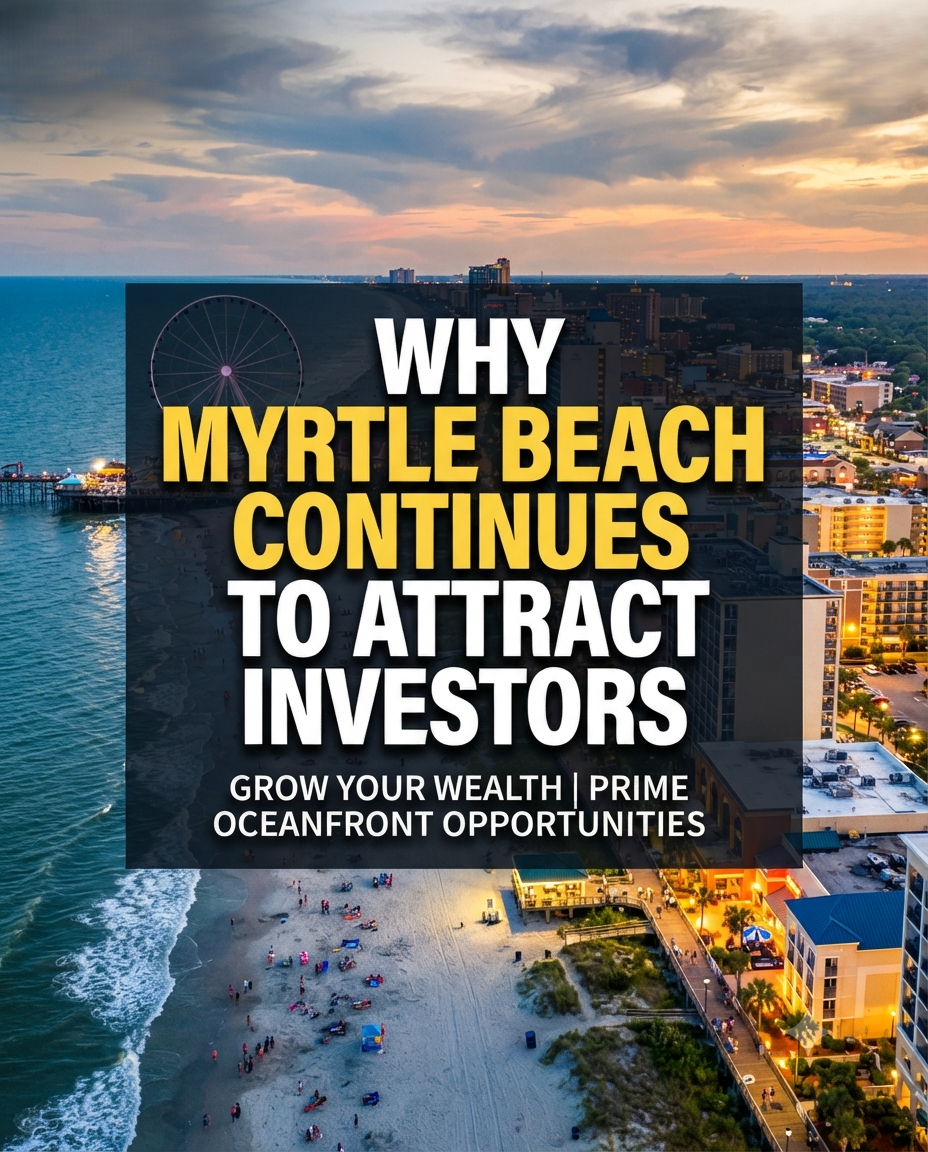
I've been talking to real estate investors in this market for over three decades, and the Myrtle Beach pitch hasn't softened — it's actually gotten stronger. The investors who walked into my office five years ago were mostly local. The investors walking in today are coming from New York, Toronto, Texas, Ohio, and increasingly from Florida and California. What changed isn't really Myrtle Beach. What changed is everywhere else. The carrying costs of investment property in many markets have climbed to a place where the math doesn't work, while Myrtle Beach has held a sweet spot that keeps generating cash. Here's why investors keep coming and what they're actually buying.
The Three Income Streams That Keep Investors Interested
The Myrtle Beach investor market isn't one thing. There are three distinct income streams that pull different kinds of investors:
Short-term vacation rentals through Airbnb, VRBO, and traditional rental management. The peak summer pricing on the right oceanfront condo can hit $400-$900 per night, and the broader season runs eight to nine months. This is the bread-and-butter investor strategy in the Grand Strand and has been for decades.
Long-term annual rentals to local workforce, retirees who don't yet want to buy, and military families. The Myrtle Beach population growth means long-term rental demand has been steady and the rents have climbed materially over the last five years.
Student housing tied to Coastal Carolina University. The parent-buyer market in Conway real estate is real, but investors also play here, buying condos and small single-family homes that can be rented to students by the room.
The investors who do best in this market usually pick one strategy and become specialists, rather than treating their property as flexible across all three.
What the Vacation Rental Numbers Actually Look Like
The honest reality of short-term rental investing in Myrtle Beach: gross rental numbers look great on the marketing material, but net returns require careful underwriting. From the closings I've watched recently:
A 2-bedroom direct oceanfront condo in a strong rental building typically grosses $50,000 to $90,000 a year, depending on view, floor, building quality, and the owner's willingness to rent during peak weekends.
After property management commission (typically 20-30 percent of gross), cleaning fees, HOA dues, special assessments, insurance, property tax (at the 6 percent second-home rate), maintenance, and platform fees, net is often 30-50 percent of gross. So $50,000 gross becomes $20,000-$25,000 net before mortgage debt service.
For investors paying cash, the cap rates on these properties currently run 4-7 percent depending on building and management efficiency. For investors financing, the math is tighter and rate cycles matter more.
The investors who outperform the market typically pick newer or recently renovated buildings, manage the property themselves rather than using full-service management, and own clean of debt within 7-10 years to maximize cash flow.
The Long-Term Rental Side of the Market
Long-term rentals get less attention than short-term in Myrtle Beach, but they're a steadier strategy for investors who don't want to deal with weekly turnover. Myrtle Beach real estate has annual rental demand that's strengthened with the population growth.
What works in this segment:
Single-family homes in established neighborhoods, particularly in Carolina Forest, Market Common-adjacent areas, and the Forestbrook corridor. Rents commonly run $1,800 to $3,200 a month depending on size, condition, and location.
Smaller condos away from the immediate oceanfront, where the HOA dues don't eat the rental return. Annual rents of $1,200 to $1,800 a month at HOA dues of $250-$450 make the math work.
Recently-built townhomes in the $250,000 to $400,000 range. Lower maintenance, predictable HOA, and steady tenant demand from military families and workforce.
Why Out-of-State Investors Keep Choosing This Market
The questions I hear from out-of-state investors are consistent. What they're responding to:
Insurance still pencils here. Coastal Florida insurance has made many similar investments impossible. The Grand Strand insurance market is more expensive than inland alternatives but materially friendlier than the Florida coast right now.
Property tax structure. The 6 percent second-home rate is higher than the primary residence rate, but South Carolina property taxes overall are still lower than most northeastern and midwestern states investors are leaving.
The vacation demand is broad and durable. Myrtle Beach attracts visitors from the Southeast, Mid-Atlantic, Northeast, and increasingly Midwest. That breadth makes the rental market less dependent on any single feeder market than many competing destinations.
Closing on a vacation rental investment property has gotten easier, with established management infrastructure and predictable rental data. Investors aren't gambling the way they would in a less-developed market.
Investor Risks That Don't Get Talked About Enough
I tell every investor who walks in:
HOA risk is the biggest under-discussed factor. A building with a fresh roof or balcony special assessment can wipe out 18 months of returns. Read the meeting minutes and the reserve study before you commit, every time, no exceptions.
Short-term rental rules are changing. Local jurisdictions across the country are tightening STR regulations. The Grand Strand has been relatively friendly, but no one should assume the current rules will hold for 20 years. Build the underwriting on conservative regulatory assumptions.
Hurricane and storm season exposure. A bad storm year can take 4-8 weeks of rental income off the calendar. Run your underwriting with that exposure baked in, not as an afterthought.
The condo financing reality. Some buildings don't qualify for conventional financing because of HOA reserves or owner-occupancy ratios. Investor financing on those buildings is harder and more expensive. Confirm financing options before going under contract.
What Investors Are Actually Buying Right Now
The active investor purchases I've watched closing this year:
Newer 2-bedroom oceanfront condos in the $400,000 to $600,000 range, financed with 25-30 percent down. The cash flow works at these numbers if the building is right.
Small single-family homes in the $250,000 to $350,000 range, often in Longs real estate or older Conway neighborhoods, rented annually to local workforce. Lower maintenance ceiling than condos, no HOA dues.
Cash purchases on older Myrtle Beach condos in the $150,000-$220,000 range. These are pure cash flow plays, often with returns that scare off financed buyers but work for cash investors.
Multi-property strategies where an investor buys 3-5 units across Conway, Myrtle Beach, and North Myrtle Beach to diversify their exposure across the market.
Two Things I Tell Every Myrtle Beach Investor
First, look at the building before you look at the unit. The HOA, the reserve study, the rental rules, the owner-occupancy ratio, and the management quality matter more for long-term returns than the specific unit you're buying. The wrong building with a great unit is a worse investment than the right building with an average unit.
Second, build conservative numbers from real comparable rental data, not from what the listing agent estimates. AirDNA, comparable booking history, and conversations with current owners in the same building give you the real picture. The number a listing agent quotes is usually the top-end best-case, not the expected case.
Key Takeaways
Myrtle Beach has held its appeal for investors because the three primary income streams — vacation rentals, long-term annual rentals, and CCU student housing — remain functional in a market where many competing destinations have priced themselves out. Insurance and property tax math still works here, the vacation demand is broad and durable, and the management infrastructure is mature. Vacation rental gross numbers look better on paper than net numbers do in practice; underwrite conservatively, plan for HOA assessments, and account for hurricane exposure. The investors who outperform pick a specific strategy and become specialists, target the right buildings before the right units, and base their numbers on real comparable data rather than listing-agent optimism. The Grand Strand isn't a passive investment market — it rewards investors who do the work and punishes the ones who don't.
About Greg Harrelson
Greg Harrelson is a seasoned Realtor® with more than 30 years of experience serving the Myrtle Beach and Grand Strand markets. As the founder of Century 21 The Harrelson Group, Greg has built his career helping buyers, sellers, and investors achieve success in every corner of the coastal Carolina real estate market. His expertise spans residential homes, investment properties, land development, and coastal condos. Known for his deep local knowledge, innovative marketing strategies, and commitment to personal service, Greg consistently helps clients reach their real estate goals while navigating the ever-changing market with confidence and precision.