I've been writing offers in Horry County for more than thirty years, and the question that keeps coming up over and over is the same one: how much does this flood zone actually hurt the value? It's a fair question, because the answer changes a lot depending on the street, the elevation, the lender, and frankly, how recent the buyer's memory of Hurricane Florence happens to be. Here's how I walk people through it when they bring me a Horry County address and ask if they should be worried.
What "Flood Zone" Actually Means Here
FEMA divides Horry County into mapped flood hazard areas. The labels that matter most in our market are:
- - Zone X — minimal flood risk. Most homes inland of the Intracoastal in places like Carolina Forest, the higher pockets of Conway, and most of Aynor sit here.
- - Zone AE — a 1% annual chance of flooding, also called the 100-year floodplain. Comes with a base flood elevation the building has to meet or beat.
- - Zone A — high risk, but no detailed elevation data, so insurance pricing depends more on the structure than the published number.
- - Zone VE — coastal high hazard, where wave action is in play. Mostly tight bands along the oceanfront.
- - Floodway — the channel itself. Very limited rebuild rights.
The Waccamaw River corridor, the Intracoastal, and the tidal stretches near Murrells Inlet and Pawleys carry the most AE and VE designations. After the 2015 floods and Florence in 2018, FEMA also updated maps in spots people didn't expect, which moved some long-standing Conway and Bucksport homes from X into AE almost overnight.
How Flood Zone Shows Up in the Sale Price
The honest answer: it depends on the buyer pool. From watching closings, here's what I see consistently:
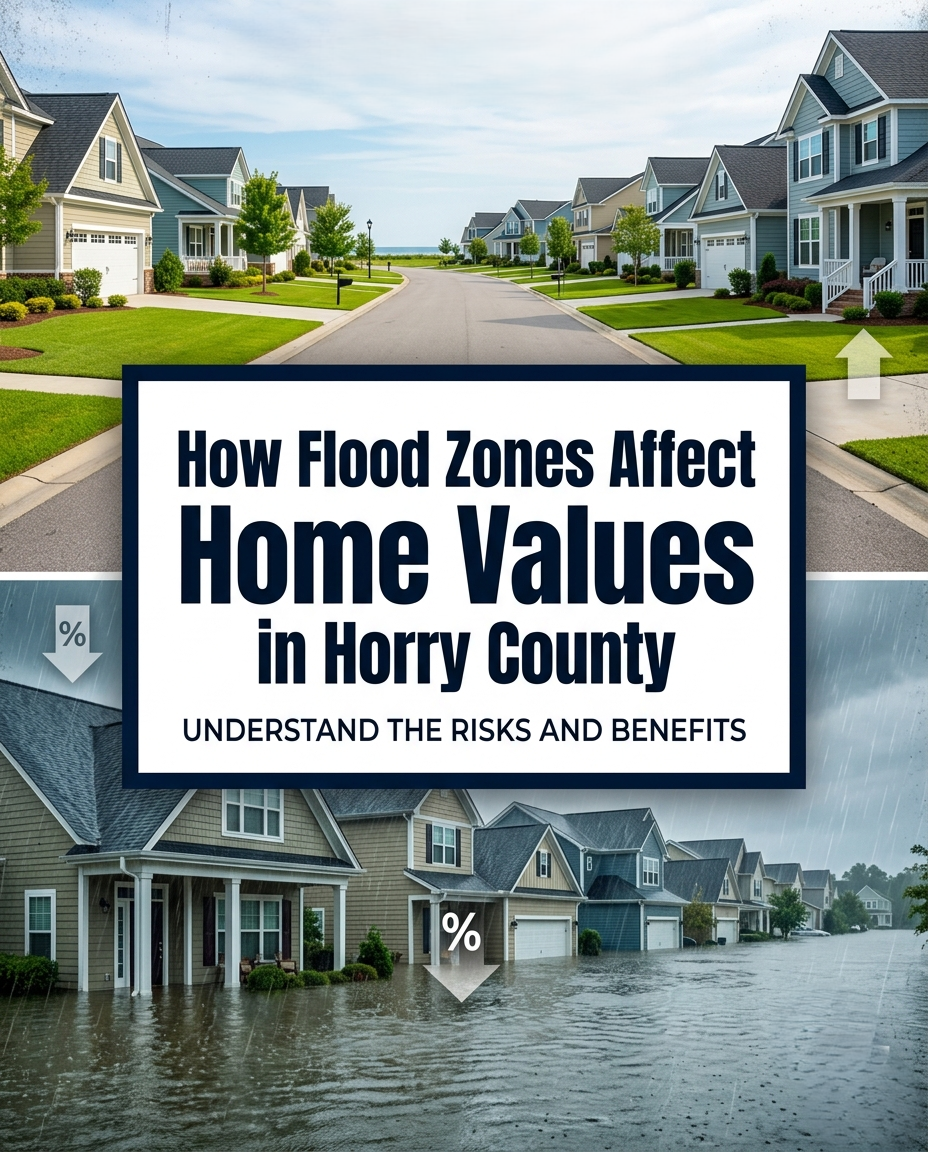
An AE zone home in a flood-aware neighborhood usually sells for about 5% to 12% less per square foot than a comparable Zone X home one street over. The discount widens when the home is older and on a slab. It narrows when the home is on tall pilings and clearly elevated above the base flood line.
A floodway designation is a different conversation. Those homes often sell well below the surrounding market, sometimes 20% or more, because the rebuild rules make insurance, financing, and future remodels harder. A few of my investor clients specifically hunt these properties when the price drops far enough.
Coastal VE zone homes don't fit the same pattern. Oceanfront buyers usually accept the zone and price it into the deal. The view does most of the heavy lifting on value, and the insurance is a known cost. For coastal buyers shopping Myrtle Beach real estate directly on the sand, the flood line isn't usually a deal-breaker — it's just a budget item.
The Insurance Math That Drives Resale
What really sets the value impact is the annual insurance bill, not the zone label itself. Two homes on the same street can have wildly different premiums because of:
- - First finished floor elevation relative to the base flood elevation
- - Whether there's an enclosure or breakaway walls below
- - The age of the structure and whether it's pre-FIRM (pre-1974 in most of Horry County)
- - Whether the current owner has a grandfathered NFIP policy that may not transfer cleanly
That last one trips up more buyers than people realize. An owner paying $1,200 a year may sell to a buyer who immediately gets quoted $3,800 because the grandfathered rate didn't follow the property. Always pull an elevation certificate and a fresh quote before you remove the inspection contingency.
For broader insurance background that matters in this market, the Conway property insurance page is a useful reference, and your insurance agent can pull the elevation certificate from the seller or order a new one.
Specific Pockets of Horry County to Know
Conway: most of the city is Zone X, but the Waccamaw-adjacent neighborhoods carry AE designations, and Bucksport sits in mixed AE/X depending on elevation. Properties one block off the river can sit in completely different rate classes.
Carolina Forest: largely Zone X, which is one reason it has been the easier-financing pocket of the market for a decade. Some communities, including Carolina Forest-area builds near the Waterway, do touch AE on the back property line, so always pull the parcel map.
Longs and inland Loris: mostly Zone X. A few low-lying spots near tidal creeks fall into AE. If you're shopping Longs real estate, the elevation differences across a single subdivision can be a few feet, which matters more than it sounds.
North Myrtle Beach, Cherry Grove, and Garden City: mixed AE and VE depending on proximity to the dunes and inlet. Cherry Grove canal homes are a special case because of the tidal effect on insurance pricing.
Two Things I Tell Every Buyer in a Flood Zone
First, the listing agent's flood zone answer is not enough. I have my buyers pull the FEMA Map Service Center result by exact street address and request the elevation certificate before they go firm. Verbal answers from anyone, including me, are just starting points.
Second, look at what the home survived, not just what the zone says. A house that came through Florence and Matthew dry is worth more in my eyes than a house in a "safer" zone that hasn't been tested yet. Ask the neighbors. Pull the seller's disclosure twice.
Key Takeaways
- - Flood zones in Horry County range from Zone X (minimal) to Zone VE (coastal high hazard), with AE and A being the most common designations along the Waccamaw and Intracoastal
- - AE-zone homes typically sell at a 5% to 12% per-square-foot discount versus Zone X comparables, with the gap widening for older slab homes
- - Floodway designations carry the steepest value impact, often 20% or more, because of rebuild and lending restrictions
- - The real value driver is the insurance premium, not the zone label — elevation certificate, finished-floor height, and grandfathered NFIP policies all matter
- - Conway, Bucksport, Cherry Grove, and Garden City have the most flood-zone activity; Carolina Forest, inland Longs, and Aynor are largely Zone X
- - Always pull the FEMA map by exact street address and get a fresh insurance quote before removing the inspection contingency
Frequently Asked Questions
Do I have to buy flood insurance in Horry County?
If your home is in Zone A, AE, or VE and you have a federally-backed mortgage, flood insurance is required. In Zone X, it's optional but increasingly recommended after the 2015 and 2018 events showed how much rain falls outside the mapped floodplain.
Does a flood zone designation always lower the resale price?
Not always. Elevated newer construction on tall pilings can sell at or above comparable Zone X homes because buyers see the structure itself as proof of risk management. The hit shows up most clearly on older slab homes that haven't been elevated.
Can I appeal a flood zone designation?
Yes, through a Letter of Map Amendment or Letter of Map Revision filed with FEMA. It typically requires a surveyor's elevation certificate showing the lowest adjacent grade is above the base flood elevation. The process takes several months but can change a home's insurance picture materially.
How do I find out my exact flood zone?
Use the FEMA Map Service Center website and search by full street address. The result will tell you the zone, the panel number, and the base flood elevation if one applies. Don't rely on a community-level designation — the line between zones can run through a single block.
What is an elevation certificate and why does it matter?
It's a survey document that records the home's lowest finished floor elevation relative to the base flood elevation. Insurance carriers use it to set premiums. A favorable elevation certificate can save thousands a year in flood insurance, and a missing one usually means the carrier prices in worst-case assumptions.
About Greg Harrelson
Greg Harrelson is a seasoned Realtor® with more than 30 years of experience serving the Myrtle Beach and Grand Strand markets. As the founder of Century 21 The Harrelson Group, Greg has built his career helping buyers, sellers, and investors achieve success in every corner of the coastal Carolina real estate market. His expertise spans residential homes, investment properties, land development, and coastal condos. Known for his deep local knowledge, innovative marketing strategies, and commitment to personal service, Greg consistently helps clients reach their real estate goals while navigating the ever-changing market with confidence and precision.