The Conway market has been one of the more interesting stories in the Grand Strand region for the last several years, and the trends heading into the middle of 2026 tell me the story isn't slowing down. After watching this market through every cycle since the early 1990s, I want to lay out what I'm actually seeing on the ground right now — the trends that matter to buyers and sellers today, not the generic real estate takes that circulate online. Some of these will surprise Conway buyers coming from outside the market. Others are patterns locals will recognize instantly.
Inventory Is Rising, But Not Everywhere Equally
The Conway market has more homes for sale right now than it did six or twelve months ago. That shift is real, but it's not uniform. The rising inventory is concentrated in specific segments:
New construction communities — especially Carsens Ferry and Astoria Park — have builder inventory sitting longer than it did in 2022 and 2023. Builders are more willing to negotiate on incentives, closing costs, and rate buydowns than they were even a year ago.
Higher-end resale, particularly homes above $600,000, is sitting longer. The buyer pool at that price point has thinned relative to peak demand.
Meanwhile, well-priced inventory under $350,000 is still moving quickly. First-time buyer demand and downsizing retiree demand keep the entry-level segment competitive.
The takeaway for buyers: the market has shifted noticeably in your favor at higher price points and remains competitive at lower ones. For sellers: pricing correctly from day one matters more than it did during the frenzy.
The Relocation Wave Has Not Slowed
Even with higher mortgage rates and more inventory, the flow of relocating buyers into Conway has held steady. The buyers I'm working with are coming from:
The Northeast — Pennsylvania, New York, New Jersey, Connecticut, Massachusetts. Property tax and cost-of-living math continue to make Conway compelling.
The Midwest — Ohio, Michigan, Indiana. Weather is part of the pull.
South Florida — Miami-Dade, Broward, Palm Beach. Insurance costs are the driver here.
Charlotte and Raleigh — increasingly common as those markets have priced themselves out for some buyers.
The relocation buyer isn't marginal — it's structural. A meaningful share of every closing I do involves someone who wasn't in South Carolina eighteen months ago. Conway benefits from this pattern because the town offers real character at prices that still work for relocators.
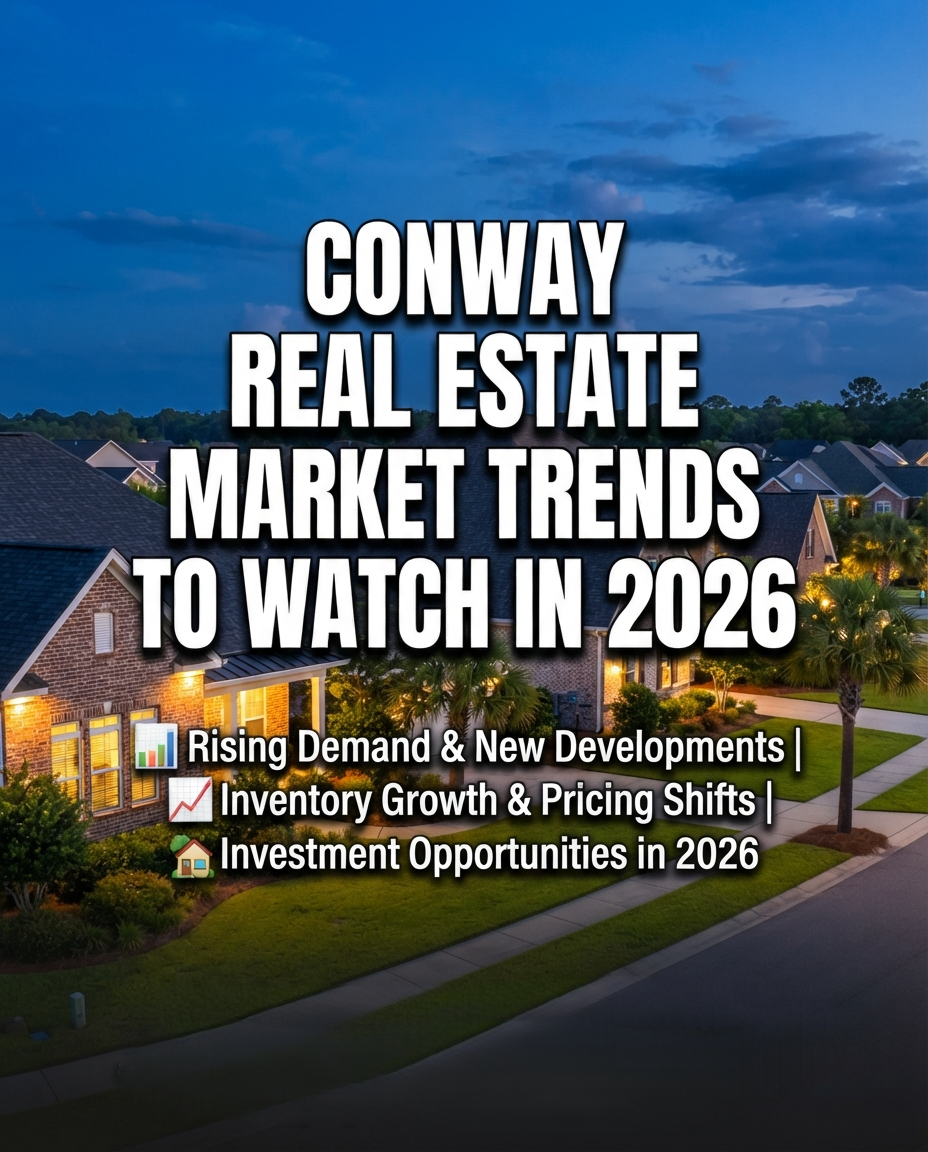
New Construction Is Adjusting to the Market
National builders active in Conway — Lennar, D.R. Horton, Beazer, Ryan, KB Home — have adjusted strategies as the market normalized. What I'm seeing:
More rate buydowns and closing cost incentives instead of price cuts. Builders protect the base prices in the community while sweetening the deal in ways that don't hit comparable sales.
Longer standing spec inventory. Homes that would have sold in 30 days a couple years ago now sit 60-90 days.
More willingness to negotiate on lot premiums and design center upgrades. Buyers who ask are getting real concessions.
Design center adjustments toward what buyers actually want — more home office layouts, more first-floor primary suites, more real storage. The Conway new construction inventory looks meaningfully different in 2026 than it did in 2022.
The Waccamaw River Corridor Has Become Its Own Segment
Riverfront and river-adjacent homes in Conway have separated from the broader market in an interesting way. Prices at these specific properties have held stronger than the general Conway market. The buyer pool for genuine river frontage is more resilient than the general home buyer pool.
What's driving it: fixed supply (the river bank isn't getting longer), emotional buyer commitment, and the long-hold pattern of Conway riverfront owners. I've closed multiple riverfront properties this year with limited on-market time, even in a broader market that has slowed.
School Zones Are Driving More Buyer Decisions
The school zone question has moved up in buyer priorities over the last couple of years. Families with school-age children are more likely to walk away from a home in the wrong zone than they were during the peak-frenzy phase. That's given some school zones — particularly the stronger elementary attendance zones — sustained pricing strength while other zones have softened.
For sellers: knowing your school zone identity and marketing appropriately is more important than it used to be. For buyers: verify the specific attendance zone before you make offer decisions, because your future resale buyer pool will care as much as you do.
HOA Fees Are Under More Scrutiny
Buyers are asking harder questions about HOA structures than they did a couple years ago. They want to see reserve studies. They want to know about upcoming assessment risk. They're calculating true monthly carrying cost that includes HOA dues, not just principal and interest.
Communities with well-managed HOAs and strong reserves are seeing that reputation help their resale values. Communities with unfunded liabilities or deferred maintenance are seeing the opposite. Wild Wing Plantation, Carolina Forest communities with active management, and the newer builder-managed communities generally hold up well. Older HOAs with aging amenity infrastructure face more challenges.
Interest Rate Sensitivity Is Different Now
Buyers today have accepted that mortgage rates aren't going back to sub-3 percent anytime soon. The buyers actively shopping have made peace with financing at 6-7 percent, and the "marry the house, date the rate" thinking has become genuinely mainstream.
What this means practically: buyers aren't sitting on the sidelines waiting for rates to drop the way they were 12-18 months ago. Buyers who need to buy are buying. That's put a floor under the market that some analysts predicted wouldn't exist.
What's Happening on the Seller Side
Sellers who list well and price realistically are still moving inventory. The market rewards discipline more than it did during the frenzy.
Sellers pricing based on last year's peak comparable sales are watching their listings sit. The correction on this has been steady rather than dramatic — 3-8 percent from peak pricing in most segments, more in higher-end inventory.
Sellers who need to sell (relocation, life change, financial need) are the ones adjusting fastest. Sellers who could hold but chose to list are more selective about whether they take offers.
What to Watch in the Second Half of 2026
Three variables that will shape the Conway market over the rest of the year:
Insurance market direction. If wind and hail costs continue to climb, some buyer pools will thin further. If costs stabilize, activity should hold or improve.
The Federal Reserve's rate path. Rate movement matters at the margins even though buyers have adapted to current levels.
New construction absorption. If builders successfully move current inventory, they'll start new projects with normal timelines. If inventory keeps sitting, we could see meaningful slowdown in new starts.
For broader market context, browsing current Conway real estate inventory alongside Myrtle Beach real estate gives you a real feel for how the segments are pricing right now.
Two Things I Tell Every Conway Buyer or Seller in This Market
First, work with data, not narrative. The Conway market you see on national real estate news isn't necessarily the Conway market on the ground. Get actual comparable sales, actual current listings, and actual insurance quotes for the specific home you're considering. Local data beats national narrative every time.
Second, don't try to time the perfect moment. Buyers waiting for the "right" time in 2026 often end up on the sidelines watching the market move. Sellers waiting for prices to return to 2022 peaks are often waiting for something that isn't coming. The right home at a fair price today, or the right listing strategy today, beats waiting for a market condition that may not arrive.
Key Takeaways
The Conway real estate market in 2026 is normalizing rather than crashing — inventory has risen at some price points while remaining tight at others, relocation demand continues to drive activity, new construction is adjusting through incentives rather than price cuts, and the Waccamaw riverfront corridor has proven especially resilient. School zone identity, HOA financial health, and total carrying cost are all playing bigger roles in buyer decisions than they did during the peak-frenzy phase. Interest rate acceptance has replaced interest rate paralysis. Sellers who price disciplined and buyers who work from actual local data continue to close successful transactions. The market rewards preparation and punishes wishful thinking. That's the reality of Conway heading into the second half of 2026, and it's a reasonably healthy setup for anyone willing to engage with it seriously.
About Greg Harrelson
Greg Harrelson is a seasoned Realtor® with more than 30 years of experience serving the Myrtle Beach and Grand Strand markets. As the founder of Century 21 The Harrelson Group, Greg has built his career helping buyers, sellers, and investors achieve success in every corner of the coastal Carolina real estate market. His expertise spans residential homes, investment properties, land development, and coastal condos. Known for his deep local knowledge, innovative marketing strategies, and commitment to personal service, Greg consistently helps clients reach their real estate goals while navigating the ever-changing market with confidence and precision.