Five years ago, buyers asked me about acreage maybe one out of every twenty conversations. Today it's closer to one out of five. Something has changed about what people want from real estate, and the demand for land in Horry County keeps climbing. I've sold farmland, timber land, residential acreage, and homes on real lots for over thirty years, and the buyer pool for land today is broader, younger, and more decisive than I've ever seen it. Here's what's actually driving the shift and what buyers should think about before they put a contract on dirt.
What Counts as "Acreage" in This Market
For most buyers, acreage means anything over two acres. Below that, you're still in the residential lot category. Once you cross two acres, the property starts behaving like land — different zoning conversations, different insurance treatment, sometimes different tax treatment, and a different buyer pool when it eventually sells.
The Horry County land market splits roughly into these segments:
Small residential acreage of 2 to 10 acres, often with a home already on it, sometimes raw. This is where most family buyers land.
Mid-size acreage of 10 to 50 acres, which captures hobby farms, small horse properties, and serious privacy seekers. Longs land for sale inventory includes meaningful options in this range.
Large acreage of 50 acres and up, which moves into farm, timber, and investment territory. Most of these properties sit in the western half of the county, around Loris, Galivants Ferry, and the back roads off Highway 905.
Why Demand for Land Has Climbed
Several patterns reinforce each other:
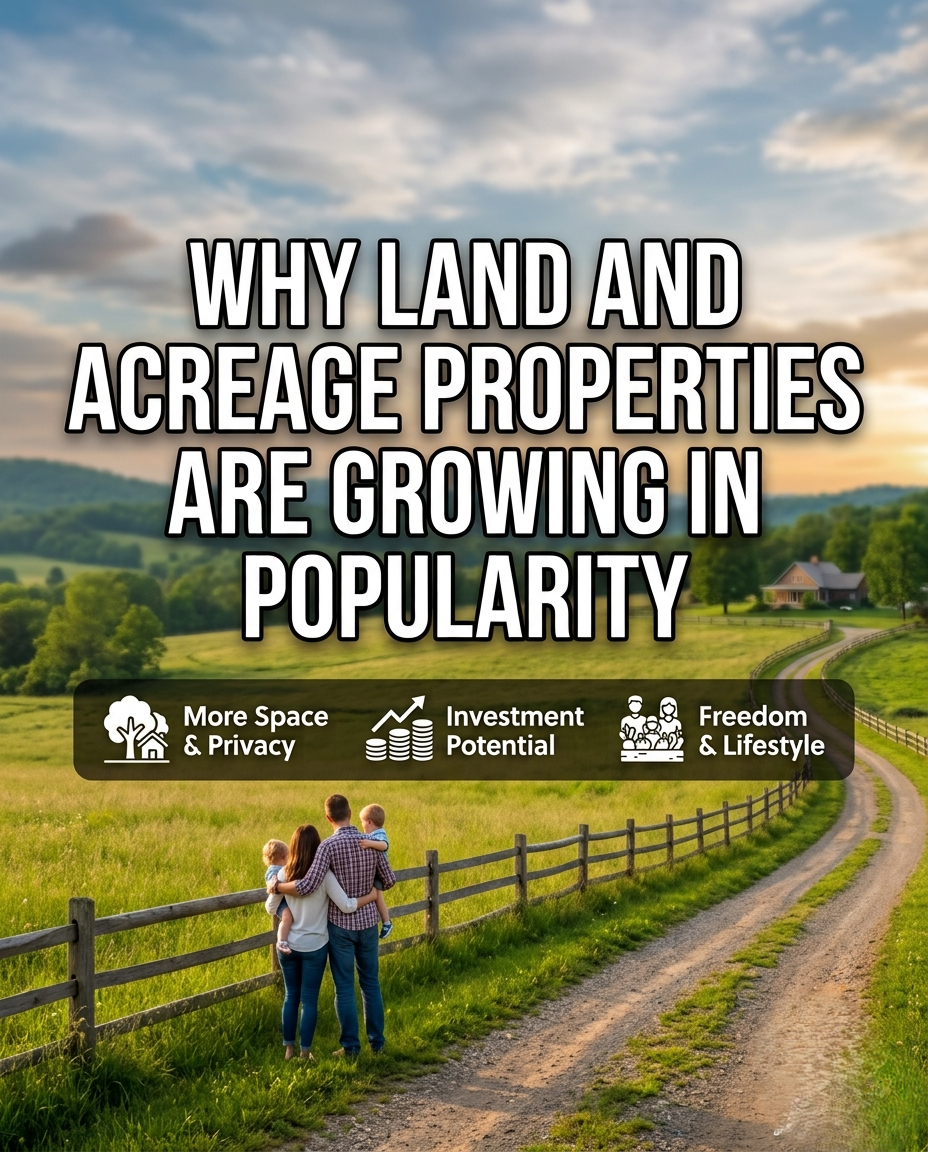
Remote work permanence. The work-from-home shift didn't fade after 2022. Buyers in their thirties and forties can now work from a property 15 miles from the nearest interstate, which was barely possible a decade ago.
The privacy premium. After three years of crowded subdivisions and constant pandemic-era exposure to neighbors, the value of a private yard with real trees and real distance from anyone else has gone up in buyers' minds. A 5-acre lot used to feel excessive. Now it feels like the right answer for buyers who can afford it.
The hobby farming, horse, and small livestock movement. More buyers want chickens, goats, a few horses, or just a real garden than I've seen in three decades. Land that supports those activities is in real demand.
Investment thesis. Land in growth-corridor counties like Horry has appreciated meaningfully. Investors who would have bought a rental house ten years ago are increasingly buying raw land, banking on continued westward development from Conway and Carolina Forest.
Multigenerational living. Families want room for a main house and an accessory dwelling for aging parents or adult children. That's hard in a tight subdivision and easy on acreage.
Where the Land Inventory Actually Sits
From most coastal to most rural:
Aynor and the back roads off Highway 501 west of Conway. Aynor real estate includes a real share of acreage properties, and the Aynor school identity is part of the appeal.
Loris and the surrounding county. Loris real estate is one of the broader inventories of true acreage in our market, both improved properties and raw land.
Galivants Ferry, Green Sea, and Nichols. These are deeper rural pockets with the most raw land per dollar in the entire region. The trade-off is a longer drive to coastal amenities and rural infrastructure quirks like spotty internet and well-and-septic everything.
The Longs and rural Conway corridor. Closer to coastal services with land still affordable enough to make sense.
What Land Costs Right Now
Realistic per-acre numbers across the county:
Wooded or tillable inland acreage in Loris, Galivants Ferry, or Aynor: $4,000 to $10,000 per acre depending on access, frontage, and zoning. Larger parcels often run lower per acre because the buyer pool shrinks.
Improved acreage with a home, well, septic, and road frontage: highly variable, but $400,000 to $700,000 for a 5-to-10-acre property with a solid home is common.
Smaller residential lots in rural subdivisions: $30,000 to $90,000 for a 1-to-3-acre lot in a planned community.
Premium acreage with water frontage, road access on a paved county road, or specific development potential can run substantially higher. The most valuable land in our market is usually the parcel with utilities to the lot line and a clear path to a building permit.
What Buyers Underestimate About Land
A few patterns I've watched land buyers learn the hard way:
Well water tests are non-negotiable. Iron, sulfur, hardness, and bacterial content vary widely from lot to lot, even on the same county road. A treatment system to make the water drinkable can run $3,000 to $15,000 depending on what you find.
Septic perc tests determine whether you can build at all. A standard gravity drain field needs soil that drains at a certain rate. If the soil doesn't perc, you either can't build or you need a more expensive aerobic system. Always confirm the perc test before going firm on raw land.
Power and internet to the lot line are not guaranteed. Some rural Horry County parcels are within 500 feet of a power line and connection is a few thousand dollars. Others require running a quarter-mile of line and connection runs $20,000 to $40,000. Confirm before assuming.
Road maintenance on private dirt roads is the owner's responsibility. Some of the best-priced acreage sits on private roads where the homeowners pay for maintenance, grading, and ditching. Budget for it.
Property tax on land alone is calculated differently than on homesteaded property. Agricultural use rates exist if you qualify, but raw land held for investment can carry surprisingly meaningful tax bills.
The Build Question
Many land buyers eventually build. The economics in Horry County right now make this challenging but workable:
Custom build costs for a well-spec'd home run $200 to $325 per square foot depending on the builder, the finishes, and the site conditions. Site work — clearing, well, septic, power, driveway — typically adds $40,000 to $100,000 depending on the lot.
The buyers who do best on a build pick the lot first, get the perc test and well water analysis done before closing on the land, and have a builder lined up with realistic timelines. The buyers who buy land first and figure out the build later sometimes wait two to three years before they can actually move in.
Two Things I Tell Every Land Buyer
First, walk the entire property at least twice, in different weather. Land doesn't show the way a finished home does. The low spot that's dry in October might be a wetland in March. Property boundaries, access points, and views all look different across seasons. The buyers who walk it twice make better decisions.
Second, talk to a neighbor before you buy. Rural Horry County is small enough that knocking on a nearby door and having a real conversation tells you things no inspection report will. Which roads flood. Which county lines run through the property. Whether the neighbor is friendly. Whether hunting season is intense in the area. A 20-minute neighbor conversation has saved more of my buyers from bad decisions than any other single thing.
Key Takeaways
The demand for land and acreage in Horry County has structurally shifted upward, driven by remote work permanence, the privacy premium, growing hobby farming and homesteading interest, multigenerational living patterns, and serious investor interest in growth-corridor land. The inventory ranges from small residential acreage close to Conway out to large tracts in Loris, Galivants Ferry, and the western back roads. Realistic prices run from $4,000 per acre on raw inland land up to $700,000 or more on improved acreage with a quality home. Buyers who do best on land deals run the well water test, the septic perc test, and a real utility cost estimate before closing. They walk the property twice in different weather. They talk to a neighbor. Land rewards patient, thoughtful buyers and punishes the ones in a hurry. The pace is real, and the value is real, but neither comes accidentally.
About Greg Harrelson
Greg Harrelson is a seasoned Realtor® with more than 30 years of experience serving the Myrtle Beach and Grand Strand markets. As the founder of Century 21 The Harrelson Group, Greg has built his career helping buyers, sellers, and investors achieve success in every corner of the coastal Carolina real estate market. His expertise spans residential homes, investment properties, land development, and coastal condos. Known for his deep local knowledge, innovative marketing strategies, and commitment to personal service, Greg consistently helps clients reach their real estate goals while navigating the ever-changing market with confidence and precision.