This is one of the most common decisions buyers face when they shop Horry County, and the right answer isn't the same for everyone. New construction has been the headline story along Highway 905, Highway 544, and the Carolina Forest corridor for years now. At the same time, resale homes in older neighborhoods have quietly held their value and, in some pockets, outperformed the new builds. After watching both ends of this market through multiple cycles, here's how I help buyers decide which side fits.
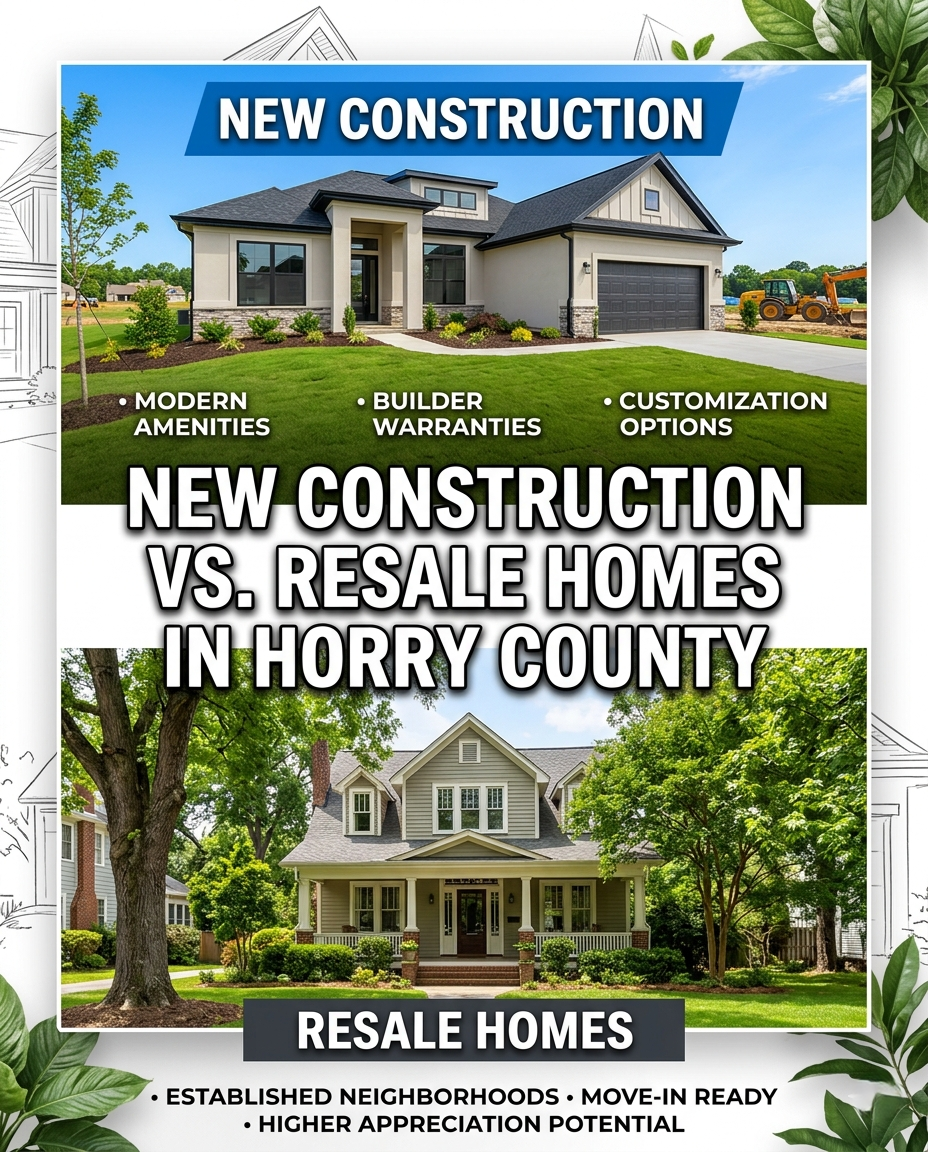
What "New Construction" Really Means in This Market
When buyers say new construction in Horry County, they usually mean a national builder like D.R. Horton, Lennar, Beazer, KB Home, Ryan, or Pulte putting up a community on raw land off a county road. The pace has been remarkable. Conway new construction has expanded by hundreds of homes a year between the Carsens Ferry, Astoria Park, and Highway 905 corridors, plus a heavy push into the Longs and Loris belt to the north.
Resale, by contrast, covers everything from a 1985 brick ranch on a half-acre lot in Conway proper to a 2018 Carolina Forest home that's been lived in for six years. Resale is the bigger pool by inventory, but it gets less marketing attention because individual sellers don't have the budget builders do.
Where New Construction Wins
New construction's biggest pull is what's behind the walls. You're getting current code, modern HVAC, foam insulation in most builds, and warranties that cover structural and mechanical issues for the first one to ten years depending on the builder. Energy bills are usually noticeably lower. The wind mitigation features built into 2024 and 2025 homes can carry meaningful insurance discounts in this coastal market.
New construction also tends to win on:
- Buyer incentives, especially rate buydowns or closing cost contributions when builders need to move inventory
- Predictable HOA covenants and amenity packages
- Cleaner financing because the home is appraisal-friendly with comparable builder sales nearby
- Lower immediate maintenance budget
Where Resale Quietly Wins
Resale wins on land, location, and character almost every time. A 1990s home on a true half-acre in Conway sits on a lot that today's builders rarely offer for the same price. Older neighborhoods have mature trees, established communities, and street layouts that the post-2015 cookie-cutter builds can't match.
You also see resale outperform new construction on:
- Proximity to downtown Conway, Myrtle Beach city limits, and historic neighborhoods
- True yard space, fenced backyards, and meaningful tree cover
- Solid masonry construction in homes built in the 70s through early 90s
- Settled foundations and predictable drainage that newer builds haven't proven yet
For buyers who want established neighborhoods with character, browsing Conway real estate resale inventory side by side with the new construction subdivisions is usually the most useful comparison. The price-per-square-foot numbers tell two different stories.
The Trap Buyers Fall Into With New Construction
I see a few patterns repeat year after year:
First, buyers assume the listing price is the negotiating ceiling. With most national builders, the listed base price is the floor for any given month, but the buyer incentives, lot premiums, and design center add-ons swing the final number much more than the base. Smart buyers ask which incentives are being offered this week, not just what's on the spec sheet.
Second, buyers under-budget the post-closing cost. New construction usually comes with no blinds, sparse landscaping, no fence, and no gutters. I've watched clients spend $15,000 to $30,000 in the first six months making the house live the way they wanted.
Third, the warranty isn't as bulletproof as buyers think. Cosmetic issues are usually fixed quickly, but settling cracks, drainage adjustments, and HVAC tuning can drag out. Document everything in writing during the walkthrough.
The Trap Buyers Fall Into With Resale
Resale has its own warning signs:
HVAC and roof age are the two budget killers I see most often on resale inspections. A 14-year-old roof or a 12-year-old HVAC system means the buyer is buying a project on top of a house. Build that into your offer.
The other resale trap is insurance. Older homes, especially those built before the mid-1990s, often miss out on wind mitigation credits that newer construction qualifies for automatically. Get the quote before you remove the inspection contingency. In Longs real estate and similar inland pockets the gap is smaller, but it still shows up on the policy.
How I Think About the Final Decision
If a buyer values predictability, low immediate maintenance, builder warranty, and modern energy efficiency, new construction usually fits. If a buyer values land, character, an established neighborhood, and a slightly lower entry price for the same square footage, resale usually fits.
One observation I've held for years: in this market, the resale homes that have been well-maintained by a long-term owner often outperform new construction over the next ownership cycle, because the new home stops being new the day you close. The buyer who sells the resale six years later isn't competing against fresh builder inventory the same way.
Key Takeaways
The new construction versus resale decision in Horry County is really a trade between predictability and character. New builds win on energy efficiency, warranties, insurance discounts, and clean financing. Resale wins on land, location, mature neighborhoods, and price per square foot in many pockets. The biggest mistakes buyers make are under-budgeting the post-closing costs on a new build and overlooking roof, HVAC, and insurance gaps on a resale. The right answer comes down to what you value in the house itself and how long you plan to own it. Buyers who hold for five to ten years should look hard at the resale side, because new construction stops being new the day the key changes hands.
About Greg Harrelson
Greg Harrelson is a seasoned Realtor® with more than 30 years of experience serving the Myrtle Beach and Grand Strand markets. As the founder of Century 21 The Harrelson Group, Greg has built his career helping buyers, sellers, and investors achieve success in every corner of the coastal Carolina real estate market. His expertise spans residential homes, investment properties, land development, and coastal condos. Known for his deep local knowledge, innovative marketing strategies, and commitment to personal service, Greg consistently helps clients reach their real estate goals while navigating the ever-changing market with confidence and precision.