The remote work shift has changed what buyers want out of a home, and Conway has quietly become one of the better answers in the Southeast for people who can work from anywhere. I've watched this pattern build for the last four or five years, and the tempo has picked up rather than slowed down. Remote workers moving to Conway aren't a fluke or a pandemic hangover — they're a structural buyer group with real reasons for landing here. Here's what's actually driving that decision and what remote workers should think about before pulling the trigger on a Conway home.
Why Conway Specifically
Remote workers who research the Grand Strand almost always start with Myrtle Beach. They quickly figure out that Myrtle Beach proper is more of a resort and vacation-rental environment than a real residential community, and they broaden the search. Conway is usually where they land within a week or two of that broadening.
What makes Conway work for this specific buyer:
Genuine downtown character. Conway has a real Main Street, real coffee shops, a walkable historic district, and a Riverwalk along the Waccamaw that people actually use. Remote workers who spend most of their day in a home office want somewhere to walk to at lunch or after work that isn't a chain restaurant on a stroad.
Reasonable housing costs relative to origin markets. Remote workers coming from northeastern suburbs or Bay Area cities find that $500,000 in Conway buys a 2,800-square-foot home with a real yard, often new construction, and often in a school zone that competes well nationally. That gap funds the move plus more.
Coastal access without coastal costs. Conway is 15-20 minutes inland, which puts residents close enough to hit the beach on Saturday but far enough that insurance, flood zone concerns, and vacation-rental noise don't affect daily life. For remote workers who prioritize quality of life over proximity, this trade is favorable.
Airport access. Myrtle Beach International handles the primary Northeast and Midwest hubs well enough for the once-or-twice-a-month commute that many hybrid workers still have. For fully remote workers who fly occasionally to see family or clients, the airport is a real asset.
The Internet Question
This is the item that decides whether a remote worker can actually make Conway work. And the answer varies more than buyers expect from a map.
Fiber has expanded significantly in Conway over the last three years. Most Carolina Forest, Wild Wing Plantation, Carsens Ferry, and Astoria Park addresses have gigabit fiber available. Historic downtown Conway is mostly covered. Newer subdivisions off Highway 501 have solid options.
Where it gets iffier: some rural Conway addresses off Highway 905, deeper into the county-line areas, and pockets of older neighborhoods still don't have fiber. Wireless and cellular home internet are usable alternatives but not equivalent for heavy video call workloads.
For remote workers, the internet check is not something to leave until inspection. Confirm by exact street address before writing an offer. It's usually a five-minute call to Spectrum, Frontier, or the local providers to verify what's available at the address.
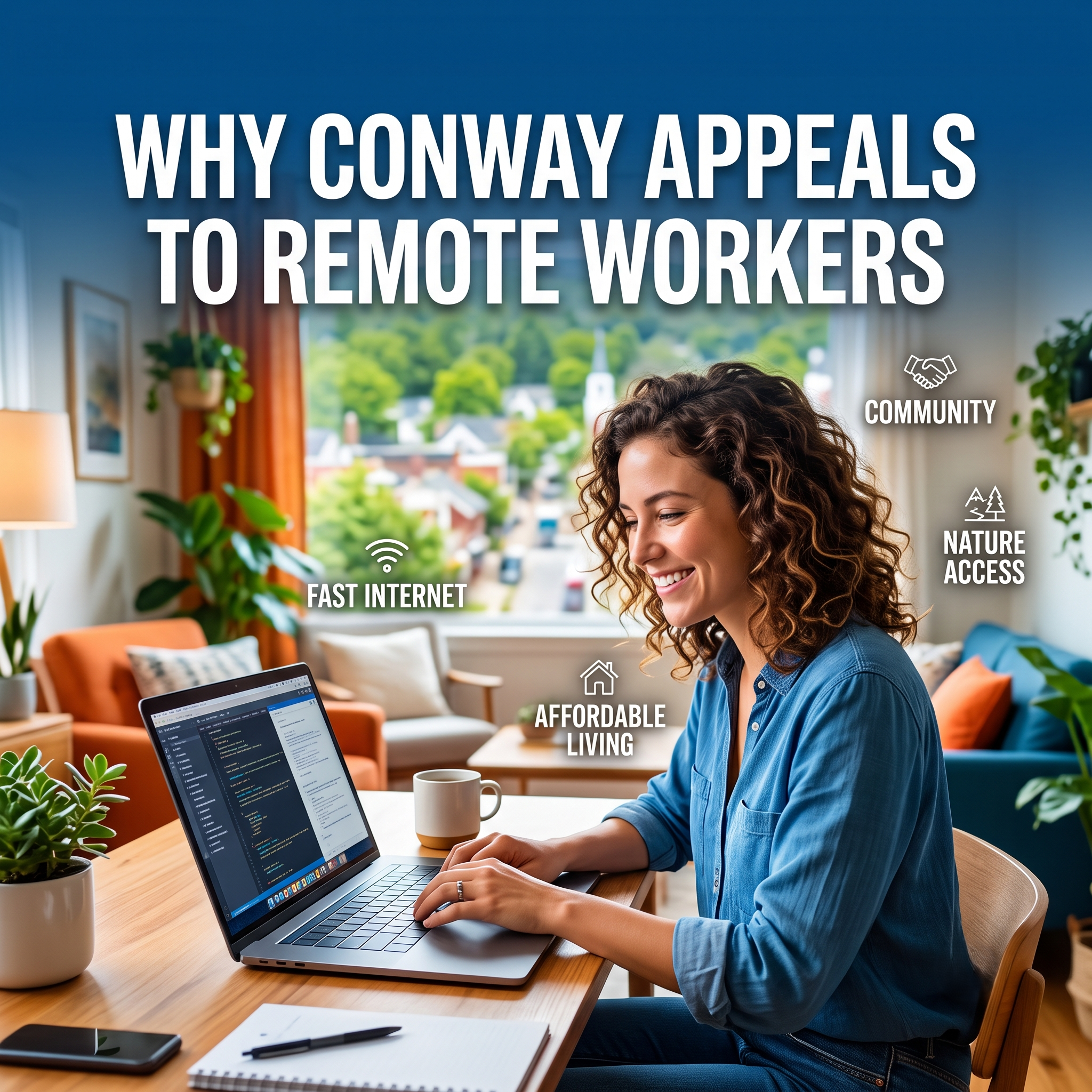
Where Remote Workers Actually Land in Conway
The landing patterns I've watched:
Historic downtown Conway. Remote workers who want a walkable neighborhood and character land on Kingston Street, Main Street, or the streets around Conway Elementary. Older homes with character, close to coffee shops and the Riverwalk, occasionally needing updates but with genuine soul. Prices from $275,000 for smaller cottages to $700,000+ for larger renovated homes.
Newer construction communities. Carsens Ferry and Astoria Park pull remote workers who want new construction with a real home office, modern HVAC, and predictable layouts. Prices $300,000-$450,000 for most family-sized homes.
Wild Wing Plantation. Wild Wing Plantation attracts remote workers who want amenities — the pool, the clubhouse, the golf course — and are willing to pay the HOA cost. Prices $350,000-$700,000+.
Larger-lot properties off Highway 905. Remote workers who want acreage, privacy, and space for a garden or workshop. These addresses require the internet check most carefully, but when the fiber is available, the properties are genuinely attractive.
Home Office Considerations Remote Workers Actually Care About
The remote workers I've helped close in Conway consistently prioritize the same features:
A separate room with a door that closes. The pandemic-era "dining table as desk" phase is over. Buyers want a real office with a door, ideally with a window and enough wall space for real bookshelves.
Quiet location within the home. A home office off the primary bedroom is quieter than one off the main living area. Buyers who take work calls all day feel this difference immediately.
Second refrigerator or coffee setup possibilities. This sounds trivial but comes up in conversation constantly. Being able to make coffee or grab a snack without leaving the workspace matters for daily productivity.
Enough electrical outlets. Older homes sometimes have one or two outlets per wall, which becomes a problem when the office has a computer, a monitor, a printer, a phone charger, and task lighting all competing.
Natural light. Video calls work better with a window behind the desk (with a shade for backlight control) rather than a fluorescent-lit interior room.
For remote workers evaluating options, browsing Conway real estate inventory with these specific features in mind narrows the field quickly.
What Remote Workers Underestimate About Conway
Two things I always warn incoming remote workers about:
The isolation is real if you don't plan for it. Working from home in a new town where you don't know anyone can be lonely fast. Remote workers who thrive here usually build in structural social time — a coworking day at a coffee shop, a weekly rec league, involvement in a local church or community group. The ones who struggle are the ones who assumed the move itself would create community without effort.
Storm season disrupts internet more than buyers expect. Hurricane season and even normal thunderstorm activity occasionally take out power and internet for extended periods. Remote workers should plan for backup — a mobile hotspot, a generator, and a work-continuity plan that doesn't assume 99.99 percent uptime.
Two Things I Tell Every Remote Worker Considering Conway
First, spend a full week here before you commit. Rent a short-term rental, work from it for a full week, and actually do your job the way you'll do it if you move. That reveals internet quality, ambient noise, coffee shop options for a change of scenery, and whether the daily rhythm actually works. A weekend visit doesn't tell you.
Second, look for the home that has the office you actually want, not the home that has a room that could become an office. Homes marketed with a real "home office" often have it — bookshelves, good lighting, dedicated wiring. Homes where the office is really a converted bedroom are usually going to require investment to get to what you actually want. Budget for that or find a home that's already there.
Key Takeaways
Conway has emerged as a structural landing zone for remote workers because it combines genuine downtown character, reasonable housing costs relative to origin markets, coastal access without coastal costs, and reliable Myrtle Beach International airport access. Fiber internet is available for most Conway addresses but not all, and the exact-address check matters more than remote workers usually expect. The landing patterns split between historic downtown for character, newer subdivisions like Carsens Ferry and Astoria Park for predictable modern homes, Wild Wing Plantation for amenities, and larger-lot properties off Highway 905 for privacy. Remote workers should focus on real home office features, spend a full week working from a short-term rental before committing, and build a structured social plan to avoid isolation. Conway rewards remote workers who do the work of finding the right specific home, and the buyers who move here well end up staying much longer than they initially planned.
About Greg Harrelson
Greg Harrelson is a seasoned Realtor® with more than 30 years of experience serving the Myrtle Beach and Grand Strand markets. As the founder of Century 21 The Harrelson Group, Greg has built his career helping buyers, sellers, and investors achieve success in every corner of the coastal Carolina real estate market. His expertise spans residential homes, investment properties, land development, and coastal condos. Known for his deep local knowledge, innovative marketing strategies, and commitment to personal service, Greg consistently helps clients reach their real estate goals while navigating the ever-changing market with confidence and precision.